Congratulations to Dr. Samad Alavi, Recipient of the 2014 Rahim Irvani Dissertation Award

Roshan Cultural Heritage Institute would like to congratulate Dr. Samad Alavi, Assistant Professor in the Department of Near Eastern Languages and Civilization at the University of Washington. In August 2014, he was the second recipient of the Rahim M. Irvani Dissertation Award, which recognizes an exceptional Ph.D. dissertation on Persian literature. He was presented with this distinction at the Tenth Biennial Iranian Studies Conference of the International Society for Iranian Studies (ISIS) in Montreal, Canada. Dr. Alavi’s dissertation, submitted to UC Berkeley in 2013, was entitled “The Poetics of Commitment in Modern Persian: A Case of Three Revolutionary Poets in Iran.”
Roshan Cultural Heritage Institute would like to congratulate Dr. Samad Alavi, Assistant Professor in the Department of Near Eastern Languages and Civilization at the University of Washington. In August 2014, he was the second recipient of the Rahim M. Irvani Dissertation Award, which recognizes an exceptional Ph.D. dissertation on Persian literature. He was presented with this distinction at the Tenth Biennial Iranian Studies Conference of the International Society for Iranian Studies (ISIS) in Montreal, Canada. Dr. Alavi’s dissertation, submitted to UC Berkeley in 2013, was entitled “The Poetics of Commitment in Modern Persian: A Case of Three Revolutionary Poets in Iran.”

In addition to teaching courses in Persian language and literature at the University of Washington, Dr. Alavi also serves as Assistant Editor (Literature and Culture) for the Journal of the International Society for Iranian Studies and as Executive Secretary of the American Association of Teachers of Persian.

News from Elahé Omidyar Mir-Djalali Fellow at The University of Chicago and Louvre Museum

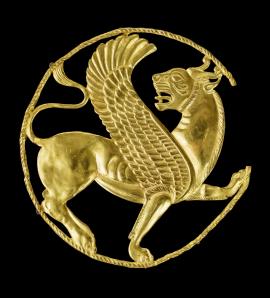
Roshan Cultural Heritage Institute is pleased to share new findings by Tytus Mikolajczak, the first Elahé Omidyar Mir-Djalali Fellow at The University of Chicago and at the Louvre Museum. Since April 2014, Mr. Mikolajczak has been documenting objects originating from the Achaemenid Persian Empire in the collections of the Oriental Institute in close collaboration with the Louvre. His report reveals that his diligent efforts have already resulted in several important discoveries.

Already within the first few weeks of the project, it turned out that the Achaemenid collection of the Oriental Institute Museum had many treasures waiting to be rediscovered. One of the most spectacular rediscoveries included stone blocks featuring Greek inscriptions, which were presumed lost. The project also brought to light numerous Persian inscriptions; fragments of pegs with inscriptions of Kings Darius I and Xerxes I; stone blocks and fragments of column bases inscribed in Old Persian; and unpublished fragments of glazed bricks from Persepolis, the decoration of which has close parallels to glazed bricks found in Susa, now in the Louvre.

The result of the yearlong fellowship will be the sharing of photographs of approximately 300 objects, and updated documentation for hundreds of additional objects with the Achemenet Project, whose online platform aims to be a reference for scholarly research and public interest in ancient Persia.

For more information on the Achemenet Project and to read the full report from Mr. Mikolajczak, please click on the links below.

read more

Roshan Institute Scholarships and Persian Language and Culture Studies Program at CSU Fresno

Roshan Cultural Heritage Institute would like to congratulate the twelve recipients of Roshan Institute Scholarship for Excellence in Persian Studies at California State University, Fresno for the 2014-15 academic year. While these students are pursuing undergraduate and graduate degrees in a wide variety of subjects ranging from Economics and Business to Physics and Computer Science, they have all demonstrated a deep interest and commitment to learning and sharing Persian language and culture.

Courses in the Persian Language and Culture Studies program at CSU Fresno are taught by Dr. Partow Hooshmandrad, Roshan Institute Endowed Faculty in Persian Language and Culture. This semester, she is offering Elementary Persian and Persian Prose and Poetry in Translation in the Department of Linguistics. She is also coordinating a number of events to promote Persian culture including musical performance, film screenings, lectures and other activities.

read more

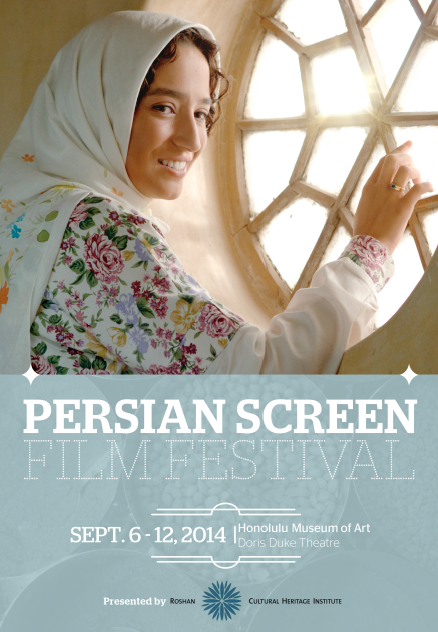
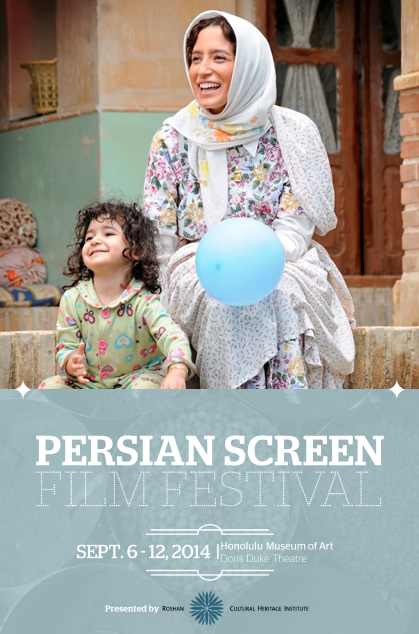
Persian Screen Film Festival Opening Night – September 6, 2014

Please join Roshan Cultural Heritage Institute in celebrating Persian cinema and culture at the Persian Screen Film Festival Opening Night at the Honolulu Museum of Art on Saturday, September 6.

Guests are first invited to taste a special Persian-inspired menu created by chef Sean Priester in collaboration with Kan Zaman in the Luce Pavilion Courtyard, before enjoying the screening of “A Cube of Sugar” in the Doris Duke Theatre. UH Manoa’s Professor Farideh Farhi will also be present to speak about contemporary Iranian cinema and the Festival’s film selection which includes four award-winning films.

Final Weeks for Roshan Institute Lecture Series at UMD and Library of Congress

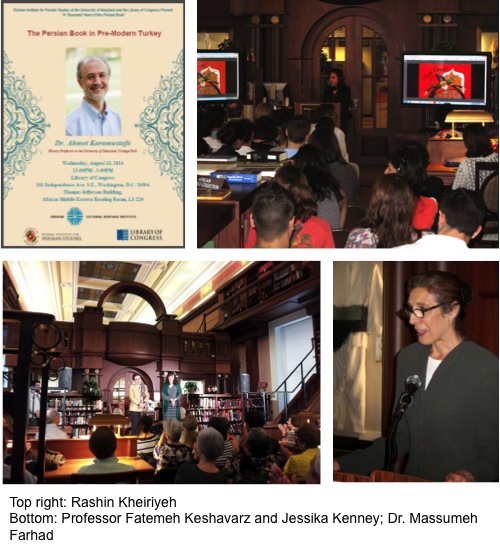
The six-month lecture series organized by Roshan Institute for Persian Studies at UMD in conjunction with the major exhibit “A Thousand Years of the Persian Book” at the Library of Congress is drawing to a close. Please join us for the final presentations:

“The Persian Book in Pre-Modern Turkey” by Professor Ahmet Karamustafa (UMD), August 13
“Forough Farrokhzad’s Biography and Unpublished Letters” by Professor Farzaneh Milani (University of Virginia), August 27

“Modern Literature in Afghanistan: Contributions to the Persian Book” by Dr. Wali Ahmadi (UC Berkeley), September 10

The World of Persian Literary Humanism: Spreading Culture through Books” by Professor Hamid Dabashi (Columbia University), September 17

Several hundred attendees have already enjoyed this lecture series since its inaugural presentation on March 27. All events are free and open to the public, and are held either at UMD or at the Library of Congress. The exhibit, which has garnered great public and media attention, will close on September 20.

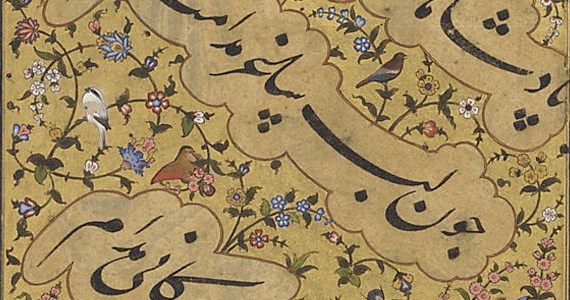
“Nasta‛liq: The Genius of Persian Calligraphy” at the Arthur M. Sackler Gallery, September 13, 2014 – March 22, 2015

“Nasta‛liq: The Genius of Persian Calligraphy” is the first exhibition of its kind to focus on nasta‛liq, a calligraphic script that developed in the fourteenth century in Iran and remains one of the most expressive forms of aesthetic refinement in Persian culture to this day. More than twenty works ranging in date from 1400 to 1600, the height of nasta‛liq’s development, tell the story of the script’s transformation from a simple conveyer of the written word to an artistic form of its own. The narrative thread emphasizes the achievements of four of the greatest master calligraphers—Mir Ali Tabrizi, Sultan Ali Mashhadi, Mir Ali Haravi, and Mir Imad al-Hasani—whose manuscripts and individual folios are still appreciated not only for their content but also for their technical virtuosity and visual quality.

read more

IHF Lectures on Iranian Archaeology by Roshan Institute Fellows Dr. Ali Mousavi and Professor David Stronach

On September 10, Dr. Ali Mousavi, Lecturer in Iranian Archaeology at UCLA, will present “Persepolis: the Life and Afterlife of a World Wonder.” The ruins at Takht-e Jamshid, known as Persepolis, are among the most formidable monuments that have gained a measure of symbolic status. The site has been the object of years of exploration from the nineteenth century to the present. Built by artists and workers of the four quarters of the civilized world in the late years of the sixth century BC, Persepolis became the richest city under the sun and was the epitome of the Persian Empire. The burning of the city in 330 BC both marked the end of the empire and the beginning of a new era: Persepolis’ afterlife. After its first destruction, the ruined city of the Persians attracted local dynasts who performed rituals and ceremonies at the site and who saw the ruins as the enigmatic deeds of their glorious ancestors. From one life to another, the site has continued to fascinate generations of kings and princes, travellers and adventurers, explorers and archaeologists. This lecture attempts to examine the history of the site as a whole from the time of its foundation down to the present day.

On September 17, David Stronach, Emeritus Professor of Near Eastern Archaeology at UC Berkeley, will speak about “Recollections of Archaeology in Iran.” Against a background of the close cooperation that existed between all the archaeologists who were working in Iran in the 1960s and 1970s, this lecture attempts to describe the activities of various of the British archaeologists who were working in different parts of Iran at this time. Sites of Iron Age to Achaemenid date will be given particular attention. The lecture will be followed by a short film on the work at Tepe Nush-e Jan that was taken in the field by Ruth Stronach. Filmed at intervals between the first season in 1967 and the fifth and last season in 1977, the film includes detailed views of the steps that were taken to reveal the monumental mud-brick architecture that was encountered at this unusually well-preserved Median site, located 60 km south of Hamadan.

Professor Farideh Farhi Speaks About Persian Screen Film Festival on HPR

Dr. Farideh Farhi, Professor of Political Science at the University of Hawaii at Manoa, was invited by Hawaii Public Radio to talk about the first Persian Screen Film Festival at the Honolulu Museum of Art. On the September 1st edition of “The Conversation,” she spoke about the Institute’s work to share Persian culture in Hawaii and beyond, and highlighted the importance of Iranian cinema in portraying contemporary society and themes. Please click on the link below to listen to the full interview.

The Persian Screen Film Festival is organized by the Doris Duke Theatre of the Honolulu Museum of Art and presented by Roshan Cultural Heritage Institute. From September 6 – 12, a total of 12 screenings will feature four award-winning films from Iran. An opening-night reception will be held on September 6 with the participation of Dr. Farhi, followed by the screening of “A Cube of Sugar.” Please click on the link below for the full Festival schedule and more information.

read more

New Grant to East-West Center for 2014 Senior Journalists Seminar

Roshan Cultural Heritage Institute is pleased to announce its continuing support of the Senior Journalists Seminar, a signature program of the East-West Center, in 2014. Launched in 2003, the Senior Journalists Seminar is a 21-day professional dialogue, study and travel program intended to enhance media coverage and elevate the public debate regarding religion and its role in the public sphere, specifically as it regards US-Muslim relations.

Designed for senior print, radio, broadcast and online journalists from the US and Asian countries with substantial Muslim populations, the Senior Journalists Seminar offers an opportunity for participating journalists to engage their peers, experts and the public on issues relevant to US-Muslim relations.The 2014 Senior Journalists Seminar program includes travel to Washington, DC; Boston, Massachusetts; Honolulu, Hawaii; Jakarta, Indonesia; and Delhi, India, from August 20 – September 11.

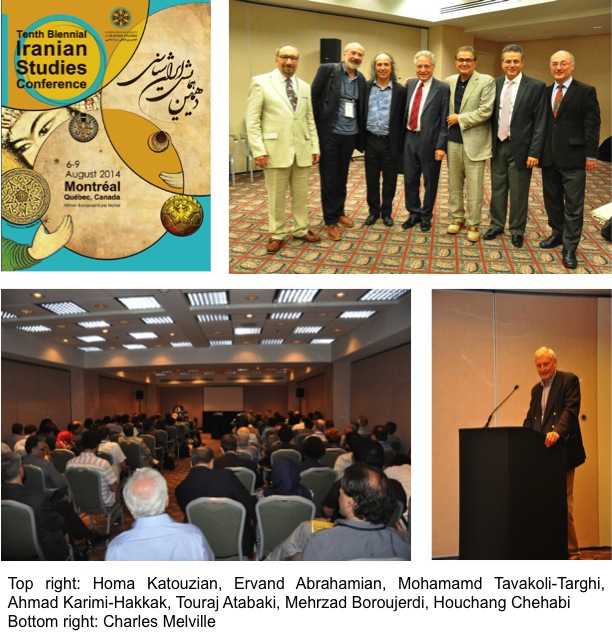
Tenth Biennial Iranian Studies Conference – Second Largest Event in ISIS History

Dr. Mehrzad Boroujerdi, President of the International Society for Iranian Studies (ISIS) reported on the tremendous success of the Tenth Biennial Iranian Studies Conference held on August 6-9, 2014 in Montreal. With 460 attendees from around the world and 100 panels organized on a wide variety of subjects in Persian Studies, this conference was the second largest event since the launch of the biennial conferences in 1998.

Roshan Institute has provided support for these efforts since 2002 and would like to congratulate the International Society for Iranian Studies on its wonderful achievement this year. We would also like to commend all of the Institute’s Fellows who presented their valuable research at this year’s event.