Outstanding Students in Persian Studies at the University of Arizona

The University of Arizona reported that four excellent students in the School of Middle Eastern and North African Studies (MENAS) received Roshan Institute Fellowships for Excellence in Persian and Iranian Studies in spring 2014. Parvaneh Hosseini is conducting her doctoral work on the subject of wrestling as the most important traditional national sport of Iran. Mehrak Kamali’s dissertation focuses on post-revolutionary Persian literature and in particular, the fictional representations of the lives of families of war veterans, martyrs and political dissidents. Sahar Aghasafari is a first year M.A. student who is exploring Achaemenid art and designs applied to fabric. Finally, Mojtaba Ebrahimian is studying the evolution of the conceptualization of modernism in Iranian prose between 1905 and 2005 for his Ph.D. dissertation.

UA also reported that several students successfully completed their Ph.D. degrees in MENAS over the past year. Farrah Jafari’s doctoral research focused on “Silencing Sexuality: LGBT Refugees and the Public-Private Divide in Iran and Turkey.” Fevziye Bahar Johnson wrote her dissertation on “Afghan Women and the Problematics of Self Expression: Silencing Sounds and Sounds of Silence” and also published “Load Poems Like Guns. Women’s Poetry from Herat, Afghanistan.” Julie Marie Ellison-Speight examined “Sadiqa Dowlatabadi: An Early Twentieth Century Advocate of Iranian Modernity” in her dissertation. In addition, Marie Donovan and Isra Yaghoubi obtained their Master’s degrees in MENAS. Roshan Institute would like to congratulate all of these outstanding students on their recent accomplishments and scholarly contributions to the field of Persian Studies.
Success of the “Cultures of the Iranian Diaspora” Conference at San José State University

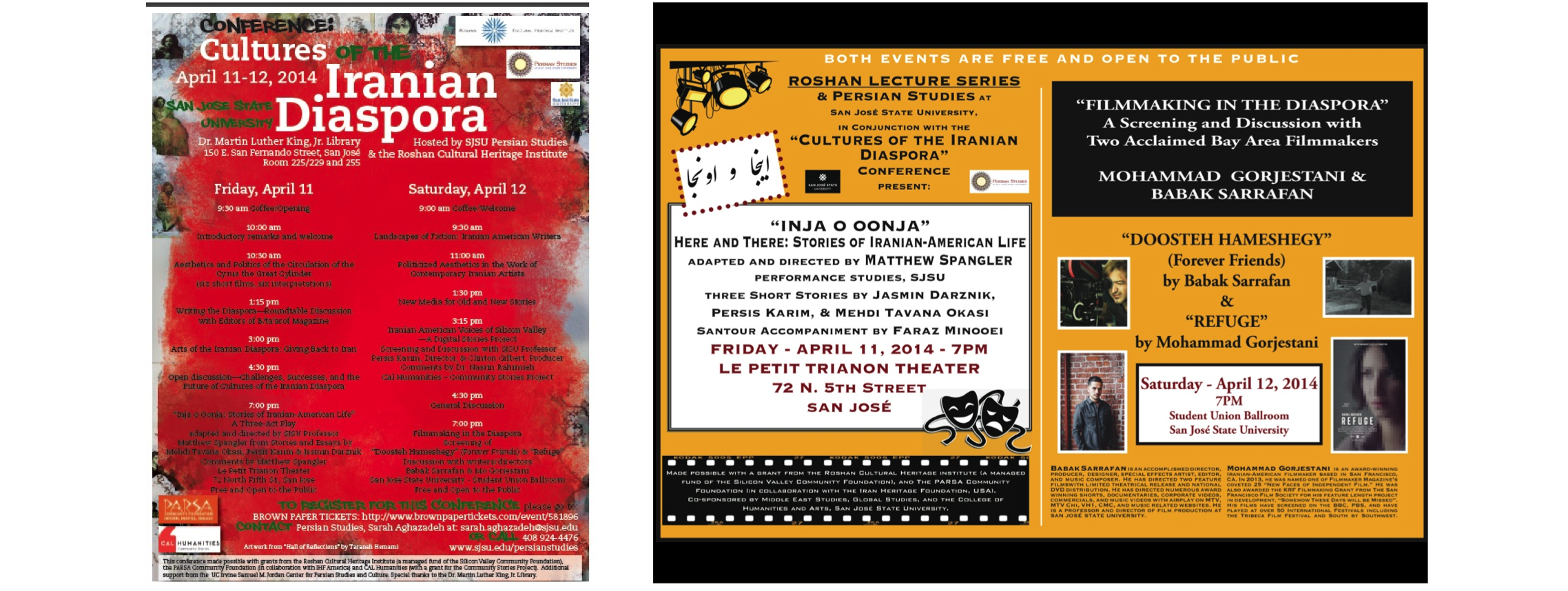
University’s Persian Studies Program reported the success of its first-ever conference on the “Cultures of the Iranian Diaspora” held on April 11-12. A total of thirty participants, ranging from writers and playwrights to artists, musicians and filmmakers, engaged the audience with their insights and challenges in representing Iran, Iranian culture and Iranian-Americans across various media. An additional feature of the conference was the screening of Dr. Persis Karim’s digital strytelling project “Iranian American Voices of Silicon Valley.” Please click on the link below for the full conference program and participant bios.

The conference was accompanied by two cultural events which attracted a large group of enthusiastic audience members. On April 11, the world premiere of “Inja o Oonja: Stories of Iranian American Life” was staged at the Le Petit Trianon Theater. Written and directed by SJSU’s own Professor Matthew Spangler, this play was a dramatic adaptation of three short stories in “Tremors: New Fiction by Iranian American Writers” (ed. Persis Karim, Anita Amirrezvani) featuring a cast of 17 actors who beautifully portrayed the challenging circumstances but ultimately triumphant experiences of Iranian immigrants.

“Filmmaking in the Diaspora” held on April 12, featured a discussion with two local Iranian-American filmmakers Babak Sarrafan and Mohammad Gorjestani, and the screening of their films “Doosteh Hameshegy” (Forever Friends) and “Refuge”, respectively.

Spring 2014 was a tremendously active semester for the promotion of Persian culture in San Jose. In addition to the “Cultures of the Iranian Diaspora” conference, the Persian Studies Program organized a wonderful musical concert of classical and folk Persian music to celebrate Noruz as well as several lectures on various subjects such as Iranian art, literature and politics. Roshan Cultural Heritage Institute would like to congratulate San Jose State University for its efforts and looks forward to another year of exciting programming.

First Roshan Institute Fellowships for Persian Language and Culture Awarded by UH Manoa

Roshan Cultural Heritage Institute would like to congratulate Richard Forster and Kavon Hooshiar on receiving the first Roshan Institute Fellowships for Persian Language and Culture in spring 2014. These fellowships are awarded to graduate students enrolled in Persian language and/or culture courses offered by the Persian Language, Culture, and Linguistics Program on the basis of their academic performance and research efforts in the field of Persian Studies.

Mr. Forster is a Ph.D. student in the Department of History whose focus is on the broader Persian-speaking world. Mr. Hooshiar is pursuing a Master’s degree in the Department of Linguistics with an interest in Persian syntax and sentence structure.

Congratulations to Roshan Institute for Persian Studies Scholarship Recipients at UMD

Roshan Cultural Heritage Institute would like to congratulate the four outstanding undergraduate students who received scholarship awards from Roshan Institute for Persian Studies at UMD this spring.

Krithi Ramaswamy and Ashley Kiani are the first recipients of Roshan Institute Scholarships for Excellence in Persian Studies. Ms. Ramaswamy is a Persian Studies minor and Ms. Kiani is a Persian Studies and Business Administration double major. 

Both began learning Persian at UMD and have shown remarkable progress. We would like to join RIPS at UMD in commending their academic excellence and enthusiasm for Persian language and culture.

Joseph Sammarco and Siobhan Cully are recipients of the Amouzegar Undergraduate Scholarships, which recognize students who have submitted exceptional papers on subjects related to Persian language or culture. Mr. Sammarco is a Persian Studies major and an active participant in UMD’s Iranian Students Association. Ms. Cully is an English major with a minor in Creative Writing, who is considering further work in Persian Studies.

International Qajar Studies Association’s Fourteenth Annual Conference

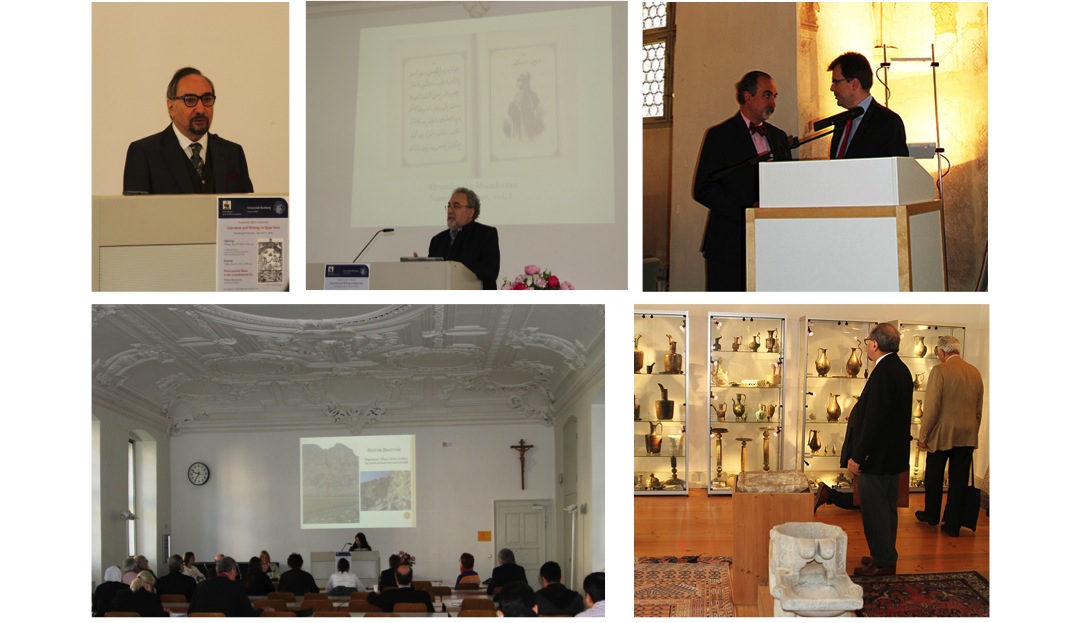
On May 30-31, 2014, the International Qajar Studies Association held its Fourteenth Annual Conference. Twenty-two distinguished historians and researchers from around the world gathered at the Iranistik Institute of the Otto-Friedrich University in Bamberg, Germany, to present their scholarly work on topics related to “Literature and Writing in Qajar Iran.” The keynote speech on “Poet-Laureate Bahar in the Constitutional Era” was delivered by Professor Homa Katouzian (University of Oxford), and was followed by several engaging panels including presentations by Professor Abbas Amanat (Yale University), Dr. Roxane Haag-Higuchi (Bamberg University), Professor Todd Lawson (Toronto University), Dr. Tomoko Morikawa (Hokkaido University), Mira Xenia Schwerda (Princeton University), and Dr. Simin Fasihi (Al-Zahra University). Several of these papers will be published in the IQSA Journal in 2015. The conference also included a reception by the Deputy-Mayor of Bamberg at the historic townhall, a visit to the Islamic Art Museum and meals. About seventy individuals attended the conference on each day. Please click on the link below to view the full conference program.

Pictured are: (top left to right) Professor Homa Katouzian (University of Oxford), Professor Abbas Amanat (Yale University), and Professor Manoutchehr Eskandari-Qajar (President, IQSA) and the Deputy-Mayor; (bottom left to right) Dr. Tomoko Morikawa (Hokkaido University) and the Islamic Art Museum.

Fourteenth IQSA Conference on May 30-31, 2014

The International Qajar Studies Association (IQSA) will hold its Fourteenth Annual Conference on May 30-31 at the Iranistik Institute of the Otto-Friedrich University in Bamberg, Germany. The IQSA is dedicated to promoting and sponsoring the study of the Qajars and the Qajar Era in all its aspects. The Fourteenth IQSA Conference will bring together thirty scholars from around the world to discuss and present research on the theme of “Literature and Writing in Qajar Iran.” The event is chaired by Professor Houchang Chehabi and co-chaired by Dr. Roxane Haag-Higuchi. Please visit the link below for more information and the list of speakers. Papers from the conference will be published in a special double issue of the IQSA 2014-2015 Journal in spring 2015. Roshan Cultural Heritage Institute is pleased to commend the efforts of IQSA to further Persian Studies and to support the conference and its publication.

Roshan Institute Appoints IT and Cultural Consultants

Roshan Cultural Heritage Institute is delighted to announce that Dr. Kaveh Abhari and Arya Mirdjalali have been appointed as IT and Cultural Consultants. We look forward to benefitting from their valuable contributions and expertise in furthering the mission of the Institute.

Dr. Abhari is an interdisciplinary researcher and program evaluator at University of Hawaii at Manoa. He works on the application of social technologies to spur learning and innovation, and contributes to several interdisciplinary studies on ICT applications to special education, public education, higher education, and alternative education. He obtained his bachelor’s and master’s degree in electrical engineering and completed his PhD in strategic marketing management as well as communication and information science.

Mr. Mirdjalali has a BSc in Computer Science from the University of Southampton (UK) and is the co-founder of techylib.com. TechyLib is a platform that enables the community of tech enthusiasts to share and learn about science and technology. He is currently a contractor and software developer at Viacom Inc. Viacom is the owner and operator of MTV networks, Paramount Pictures and over 170 other media networks around the world.

Traditional and Contemporary Persian Music at the Louvre Museum

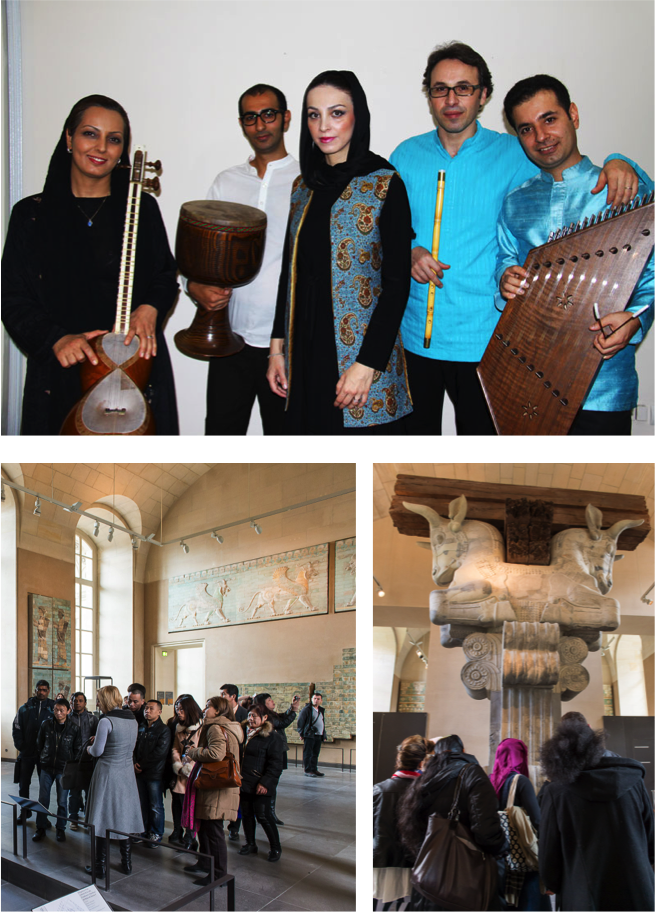
The Louvre Museum is holding two special concerts celebrating Persian music this month. On May 17, Pantea Alvandipour will perform pieces from the Qajar Dynasty, in particular from mid-19th century to mid-20th century. On May 18, Maede Tabatabai Niya will interpret original works composed by Siamak Jahangiry. Both of these talented vocalists will be accompanied by the Delgosha Ensemble, composed of Siamak Jahangiry (ney), Maryam Gharasou (tar lute), Ali Bahrami Fard (santour cithara) and Pasha Karami (percussions). Please see the attached concert program for more details (available only in French).

The Louvre organized another event showcasing Persian culture this spring. On March 24, on the occasion of the International Women’s Day and Noruz, more than 200 participants were treated to a full day of guided tours on Persian art and artifacts. They visited the Department of Islamic Art and the Department of Near Eastern Antiquities where they admired and learned about masterpieces and treasures of Persian art and archaeology in the Museum’s collections.

The Wide World of Persian: Connections and Contestations, 1500-Today

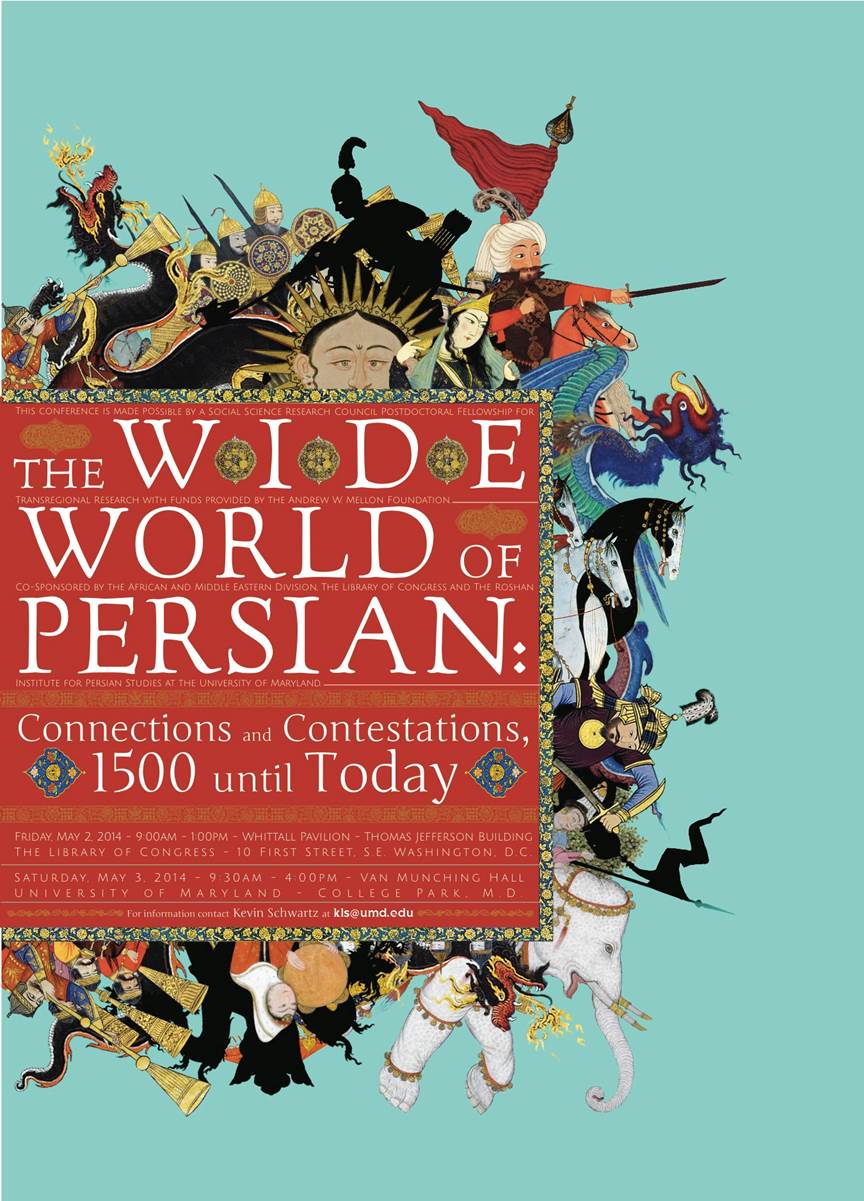
The Library of Congress’ African and Middle Eastern Division (AMED) and Roshan Institute for Persian Studies at the University of Maryland present a two-day conference entitled “The Wide World of Persian: Connections and Contestations, 1500-Today” on May 2-3, 2014. The period from early modern to contemporary times features some of the defining moments in the lifespan and legacy of the Persian world. This was a period that witnessed immense interchange and connection at the height of the Ottoman, Safavid, and Mughal Empires, tension and contestation with the rise of vernacular languages, colonialism, and nationalism, as well as eventual contraction to a world largely confined to places where Persian has served as a national language. This was also a period marked by “connections and contestations” between the different peoples and places for whom engagement with Persian remained a crucial enterprise. Long-standing transregional currents and emergent local trends produced both broad similarities and stark contrasts regarding the role of Persian literary and cultural norms for different peoples and places.

The workshop seeks to examine this period that includes not only aspects of cohesion and fracture but also renewal and reconstitution of the Persian-speaking world. It asks participants to consider how “connections and contestations” around language, literature, and culture helped define the shifting contours of the wide world of Persian at different moments and places. How did local understandings and engagement with Persianate norms change during this time? What have been the transnational and transregional spaces that allow(ed) for the manifestation of Persian cultural, linguistic, and political norms and their ability to connect (or distinguish) various peoples and places throughout this period? How have the “connections and contestations” linked to Persian shaped the literature, culture, history, and politics of the Persian world today?

Hundreds Celebrate Persian Art and Culture at the Louvre Museum This Spring

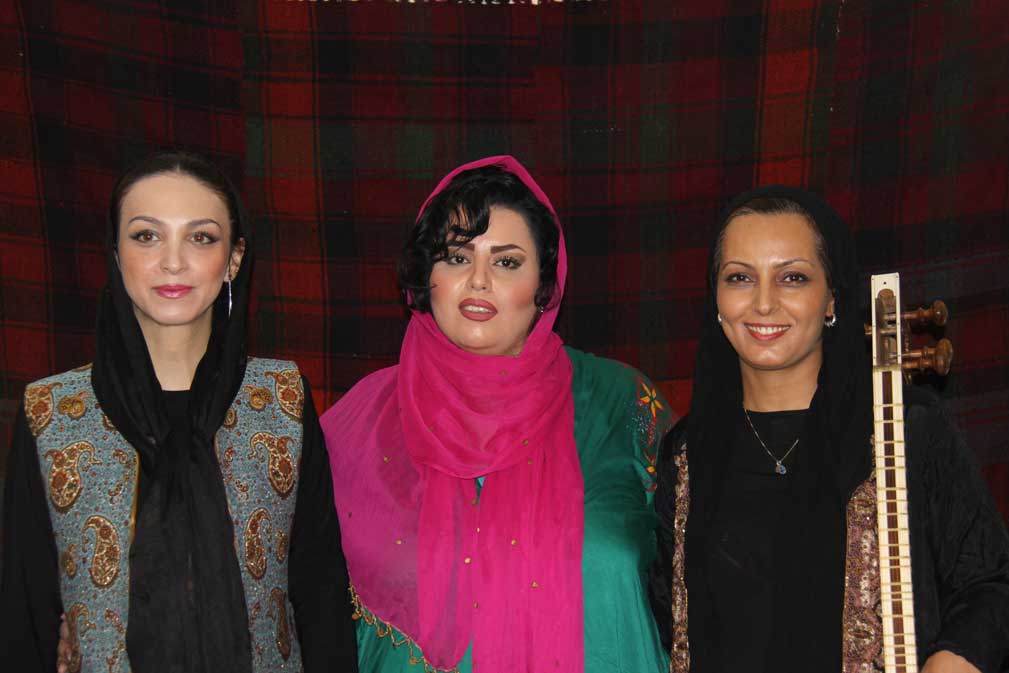
The Louvre Museum reported the resounding success of two spring concerts celebrating Persian music. On May 17, vocalist Pantea Alvandipour performed classical repertory from the 19th century, accompanied Siamak Jahangiry (ney), Maryam Gharassou (tar lute), Ali Bahrami Fard (santour cithara) and Pasha Karami (percussions). This was a moving experience for Ms. Alvandipour, who has never performed in front of an audience and outside of Iran. This event was attended by an enthusiastic crowd of 350 people who gave the performers a standing ovation. Maede Tabatabai Niya was also applauded by a lively audience of 300 people for her mesmerizing performance of original works composed by Mr. Jahangiry on May 18. She, too, was accompanied Mr. Jahangiry, Ms. Gharassou, Mr. Bahrami Fard and Mr. Karami.

On March 24, on the occasion of International Women’s Day and Noruz, the Louvre organized a full day of guided tours dedicated to Persian and Islamic art. This program was part of the Museum’s outreach efforts and was attended by almost 200 participants who enjoyed learning about the artwork presented in the Department of Islamic Art and the Department of Near Eastern Antiquities. The Elahé Omidyar Mir-Djalali Fund, established at the Louvre Museum in 2011, made possible these tours as well as the concert series.

In addition, the first Elahé Omidyar Mir-Djalali Fellow, Tytus Mikolajczak, began his fellowship work this spring at the Oriental Institute Museum (OIM) of the University of Chicago in collaboration with the Louvre. Mr. Mikolajczak’s efforts through spring 2015 will focus on documenting approximately 350 objects selected by one of the Project Directors, Professor Pierre Briant (Collège de France), from more than 2,500 pieces in the OIM’s Achaemenid collection. As a result of the fellowship, detailed and illustrated records on hundreds of stone vessels, glazed brick fragments, coins, cylinders and architectural elements all originating from the Achaemenid Empire will be made available on the website of the Achemenet research program.

Top left to right: Maryam Gharassou, Pasha Karami, Pantea Alvandipour, Siamak Jahangiry and Ali Bahrami Fard; bottom (© Artéphoto.com – Stéphane Olivier – Musée du Louvre): tours in the Persian art galleries.