Dr. Keshavarz’s Lecture and Book Signing at the Library of Congress

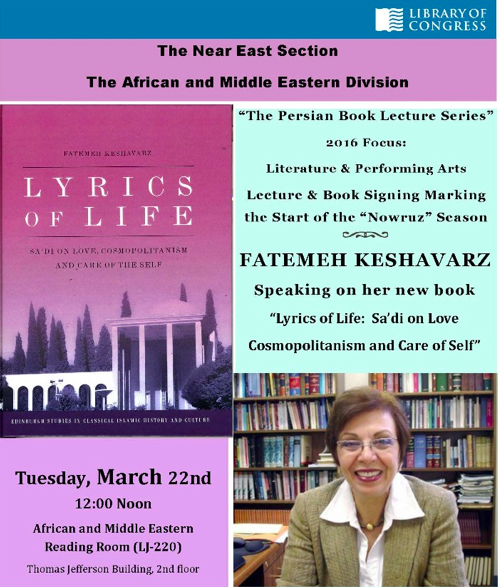
Roshan Cultural Heritage Institute is pleased to announce a lecture and book signing with Dr. Fatemeh Keshavarz, speaking on her new book Lyrics of Life: Sa’di on Love Cosmopolitanishm and Care of Self, as part of The Persian Book Lecture Series at the Library of Congress.

Dr. Keshavarz is the Roshan Institute Chair in Persian Studies and Director of the School of Languages, Literatures and Cultures at the University of Maryland, College Park. She is a published poet and author of six books including Reading Mystical Lyric: the Case of Jalal al-Din Rumi, Recite in the Name of the Red Rose: Poetic Sacred Making in Twentieth Century Iran, and Jasmine and Stars: Reading More than Lolita in Tehran. In 2009, her NPR appearance on ‘On Being: The Ecstatic Faith of Rumi’ received the Peabody Award, and she received the Hershel Walker Peace and Justice Award.

Lyrics of Life focuses on the works of the master medieval poet Sa‘di of Shiraz (d. 1291), one of the funniest, most influential and lyrical figures in classical Persian poetry.

Tuesday, March 22, 2016 | 12:00 p.m. – 1:30 p.m. | Thomas Jefferson Building, African Middle Eastern Reading Room, LJ-220 | Library of Congress
Find out more about the event

Noruz Mobarak from Roshan Cultural Heritage Institute!

cherished Persian celebration goes back at least 3000 years and is about “Celebrating Life renewal in health and harmony with nature”

Noruz – literally “New Day” – is the Persian New Year and symbolizes renewal and rebirth. The celebration of Noruz dates back several thousand years, to the time of the Achaemenids. Noruz starts at the exact instant of the Vernal Equinox, which occurs each year around the 21st of March, the first day of spring. This most important Iranian holiday is a time for family and friends to gather together and is marked with a myriad of activities affecting everything from preparations and celebrations to food, clothing, gift giving, charity, and many other social and family activities.

Haftsin (Haft Seen) is the spread, around which the Family gathers to celebrate Noruz. Iranians take pride in putting together an attractive and elaborate spread to represent both spiritual and worldly symbols promising a happy start of the New Year. The Persian word Haft means seven and Sin refers to the sound /S/ in the language. Usually a nice embroidered fabric is used as the foundation of the spread. On the spread seven specific items starting with the sound /S/ are displayed. The set is prepared a day or two before Noruz and given a place of honor in the house to remain 13 days following Noruz. Additional items are also placed on the Haftsin that will signify renewal, life, happiness, spiritual purity, prosperity, fertility, growth, good health and all things one desires for the New Year. This celebration is one of hope, promise and good fortune to enjoy and share with friends and family.

List of items for Haftsin

# Name Definition Symbolism
1 Sabzeh Spring Sprouts Growth, prosperity and togetherness
2 Senjed Dry fruit of lotus, “mountain-ash” Tart and sweet tastes in life
3 Seeb Apple The oldest beneficial fruit
4 Samanu Wheat Pudding A sweet prepared with the extract of young growth of wheat
5 Serkeh Vinegar An astringent agent, medicinal
6 Somagh Crushed Sumac Berries The oldest beneficial condiment derived from a plant
7 Seer Garlic The oldest bulb with medicinal Value
8 Sekkeh Coins, (Silver and Gold) Permanence and prosperity
9 Sombol Hyacinth Flower Life development: flower from the bulb to the roots
10 Mahi Gold fish Life energy
11 Ayne A Mirror Purity and clarity
12 Sham’ Two Candelabras Spiritual light and warmth
13 Tokhm-e Morgh Decorated Eggs Life in potential
14 Scriptures Koran, Bible, Torah, etc. Blessings and faith
15 Sepand, Esfand Wild Rue Incense against the evil eye that helps the lungs function

Louvre Museum: A Day in Persian Art, Guided Tours

Roshan Cultural Heritage Institute is delighted to announce that the Louvre Museum will host again “A Day in Persian Art” guided tours as part of Noruz celebration.

Due to the success of the event since 2014, the Louvre is hosting the guided tours on two separate days this year: Thursday, March 17, and Friday, March 18, 2016. Led by Fabienne Martet, Manager of Outreach and Education Program, the tours offer a unique opportunity to discover the wonders of Persian art and culture held at the Islamic Art and the Near Eastern Antiquities galleries.

The guided tours last an hour and a half, and are made possible with the support of the Elahe Omidyar Mir-Djalali Fund at the Louvre Museum.

Free Screening of “Frame by Frame” at Roshan Institute for Persian Studies at the University of Maryland

Roshan Institute for Persian Studies at the University of Maryland, College Park, is presenting a free screening of Frame by Frame on Sunday February 21, 2016, from 5:00-7:00pm, at UMD Stamp Building.

Frame by Frame is an award-winning documentary about photojournalism and free speech in Afghanistan. Following the screening, producer and lead translator Baktash Ahadi will lead a discussion of key ideas reaised int eh film, including humanitarian issues, women’s rights, free speech, and the challenge of translating Persian.

The screening is free and open to the public.

Read more about this event at UMD

Spring 2016 Roshan Institute Lecture Series at San José State University

The Persian Studies Program at San José State University is holding several exciting lectures this spring designed to celebrate Persian art, literature and culture. On February 2, author of Better Than War, Siamak Vossoughi will share a reading of “Stories Make a Home.” On February 25, Dr. Amy Malek, Scripps College, will deliver a lecture on “Producing Culture & Citizenship in the Iranian Diaspora.” The screening of A Woman Walks Home Alone at Night, a film directed by Ana Lily Amirpour, will be held on March 3, followed by a concert of Persian Music with Saba Ensemble for Noruz on March 6. Finally Dr. Dariush Zahedi, UC Berkeley, will deliver a lecture on “Impact of the P5 + 1 US-Iran Relations.”

All lectures are free and open to the public.

Roshan Cultural Heritage Institute is delighted to support these events and the Persian Studies Program of SJSU.

Read more about Persian Studies at SJSU

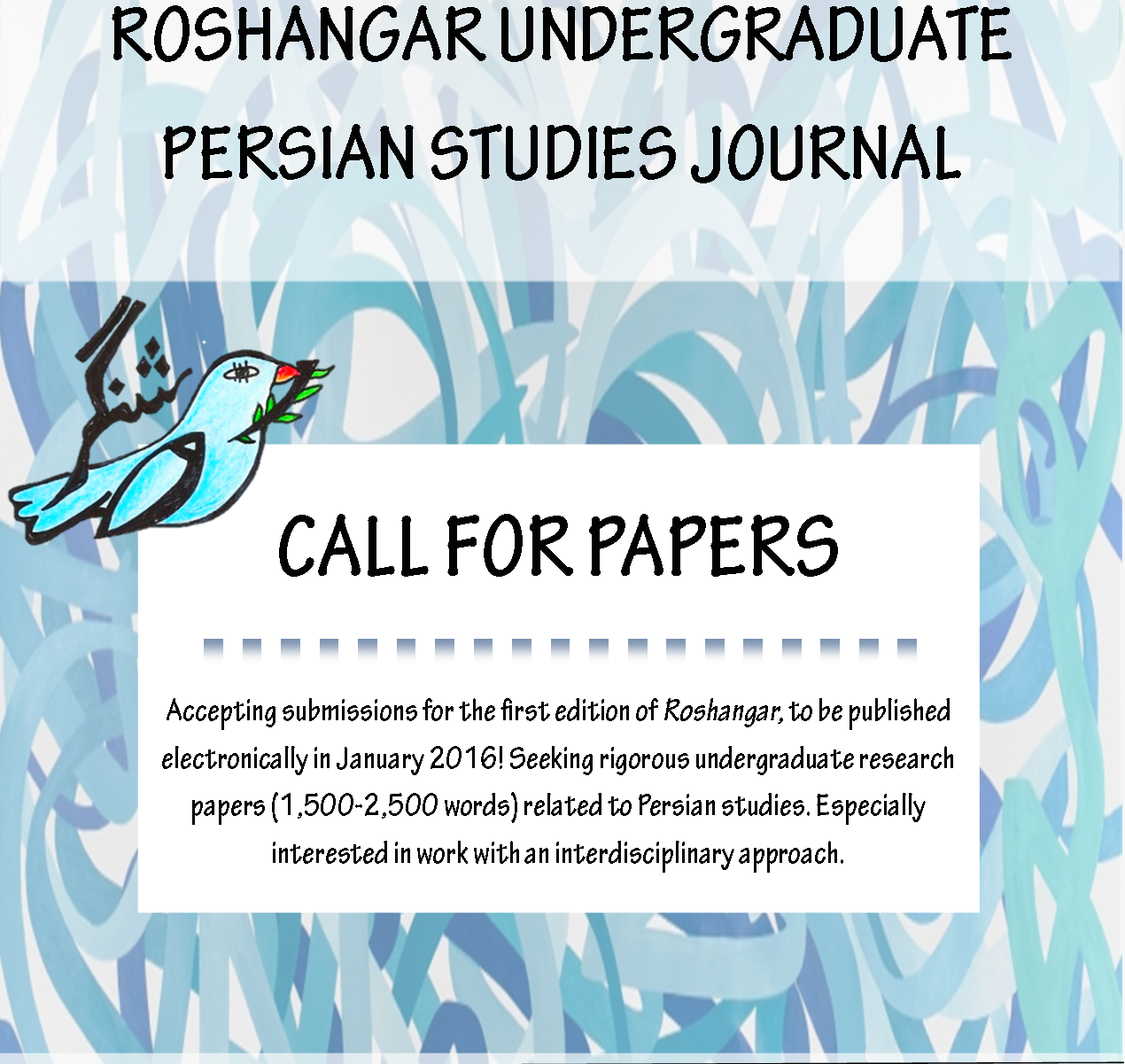
Launch of Roshangar: the Roshan Undergraduate Persian Studies Journal at UMD

It is with great joy that Roshan Cultural Heritage Institute announces the launch of Roshangar, the very first undergraduate journal in Persian Studies at Roshan Institute for Persian Studies, University of Maryland. This biannual academic publication is totally designed and run by a group of talented undergraduate students, under the guidance of former Roshan Institute Fellow, Ida Meftahi, Visiting Assistant Professor at Roshan Institute for Persian Studies.

The peer-reviewed journal is accompanied by the Roshangar website, which features film and book reviews, interviews with scholars and artists, as well as highlights of local Persian events.

Submission of high quality research papers (1,500-2,000 words) is open to all undergraduate students nationally and internationally, as long as they are related to Persian Studies.

The first edition of Roshangar will be published electronically in January 2016.

New Roshan Institute Professorship in Persian Studies at University of North Carolina Chapel Hill

Roshan Cultural Heritage Institute is pleased and proud to announce a new endowment at UNC-Chapel Hill for the establishment of Roshan Institute Professorship in Persian Studies, in the College of Arts and Sciences.

This grant creates the first Persian studies endowed professorship at Carolina. Housed in the Department of Asian Studies, the new faculty member will teach Persian language and culture courses, and enable the university to offer a minor in Persian Studies.

In 2013, Roshan Cultural Heritage Institute established an endowment for Roshan Institute Fellowship for Excellence in Persian Studies for graduate students at UNC-Chapel Hill. The two endowments combined bring the Institute’s total gifts to $1 million in support of the university’s growing Persian studies program.

Chaired by Dr. Carl Ernst, William Kenan Distinguished Professor of Religious Studies, the Persian studies program is supported by the department of Asian studies in the College of Arts and Sciences and the Carolina Center for the Study of the Middle East and Muslim Civilizations.

Read more about the Endowment at UNC

Parsi Textiles Exhibition at East-West Center Gallery

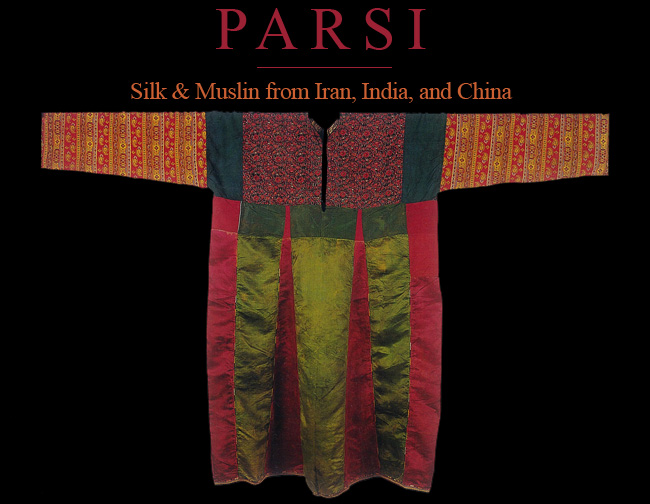
Roshan Cultural Heritage Institute is delighted to announce the upcoming Exhibition: Parsi Silk & Muslin from Iran, India and China, at the East-West Center Gallery in Honolulu, from October 11, 2015 to January 24, 2016.

Curated by Pheroza J. Godrej, Firoza Punthakey and Michael Schuster, this exhibition focuses on Parsi textiles, highlighting aspects of the long and varied development of the Parsi community. From the 8th through the 10th centuries, the Parsis emigrated from Central Asia/Greater Persia to South Asia (they are the smallest recognized ethnic group in India) when Islam was overtaking the region and marginalizing the once-dominant Zoroastrian religion.

Parsi clothing demonstrates elements borrowed from Iran, India, Victorian-era England, and China. The exhibit emphasizes the continuity of Parsi culture, giving insight into the Zoroastrian religion and its Persian roots, the history of the community and its rich and complex culture.

Find more about the Parsi Textiles Exhibition

University of Washington Persian and Iranian Studies Gala

The UW Persian and Iranian Studies Program announced its Autumn Gala will take place on Saturday, October 17, 2015, from 6:00pm to 9pm, at the Mercer Island Community Center, 8236 SE 24th Street, Mercer Island, WA.

Guests will enjoy a catered dinner, live performances and an auction. Speakers include several UW faculty: Professor Selim Kuru, Chair of the Near Eastern Languages and Civilization Department and Director, Persian and Iranian Studies Program; Professor Samad Alavi, Assistant Professor of Persian and Iranian Studies; and Joel Walker, Jon Bridgman Associate Professor of History. The keynote speaker is Babak Parviz, Vice President at Amazon and Affiliate Faculty at UW.

Organized and presented by community members, in collaboration with UW, the Gala will raise funds for the Persian and Iranian Studies program, students and faculty. Roshan Cultural Heritage Institute is proud to support the event and is offering a matching grant.

Welcome to Dr. Mohamad Navid Bazargan at Roshan Institute for Persian Studies

Roshan Cultural Heritage Institute is delighted to welcome Professor Mohamad Navid Bazargan to the faculty of Roshan Institute for Persian Studies at the University of Maryland, College Park, starting fall 2015. He will hold the position of Visiting Assistant Professor in the area of Persian literature and culture.

Professor Bazargan has been an Assistant Professor of Persian Literature at Tehran Azad University since 2005. During this time, he has served on the academic Boards of The Great Encyclopedia of Islam, The Encyclopedia of the Persian Language, and as editor of Journal of Culture and Literature at Azad University in Roudehen. He was a Visiting Scholar at California State University of Northridge from 2013 to 2014. Dr. Bazargan’s scholarship spans canonical texts such as the Shahnameh and the Masnavi. And, his studies, talents and personal involvement in modern literature, painting and calligraphy greatly enrich his work.

Find more about Roshan Institute for Persian Studies