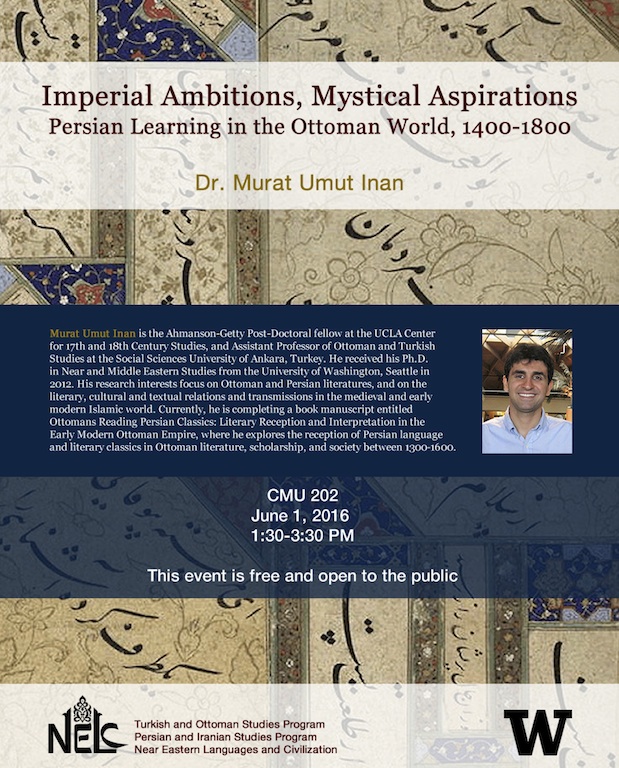
Persian Learning in the Ottoman World, 1400-1800, Lecture by Dr. Murat Umut Inan at the University of Washington

Roshan Cultural Heritage Institute is pleased to announce Imperial Ambitions, Mystical Aspirations: Persian Learning in the Ottoman World, 1400-1800, a lecture by Dr. Murat Umut Inan, hosted by the Persian and Iranian Studies Program and the Turkish and Ottoman Studies Program at the University of Washington.

Dr. Murat Umut Inan is the Ahmanson-Getty Post-Doctoral Fellow at the UCLA Center for 17th and 18th Centuries Studies. He received his Ph.D. in Near and Middle Eastern Studies from the University of Washington in 2012. His research interests focus on Ottoman and Persian literatures, and on the literary, cultural and textual relations and transmissions in the medieval and early modern Islamic world. Currently, he is completing a book manuscript entitled Ottomans Reading Persian Classics: Literary Reception and Interpretation in the Early Modern Ottoman Empire, where he explores the reception of Persian language and literary classics in Ottoman literature, scholarship, and society between 1300-1600.

The lecture is free and open to the public.

Wednesday, June 1, 2016 | 1:30 p.m. – 3:30 p.m. | CMU 202 | University of Washington
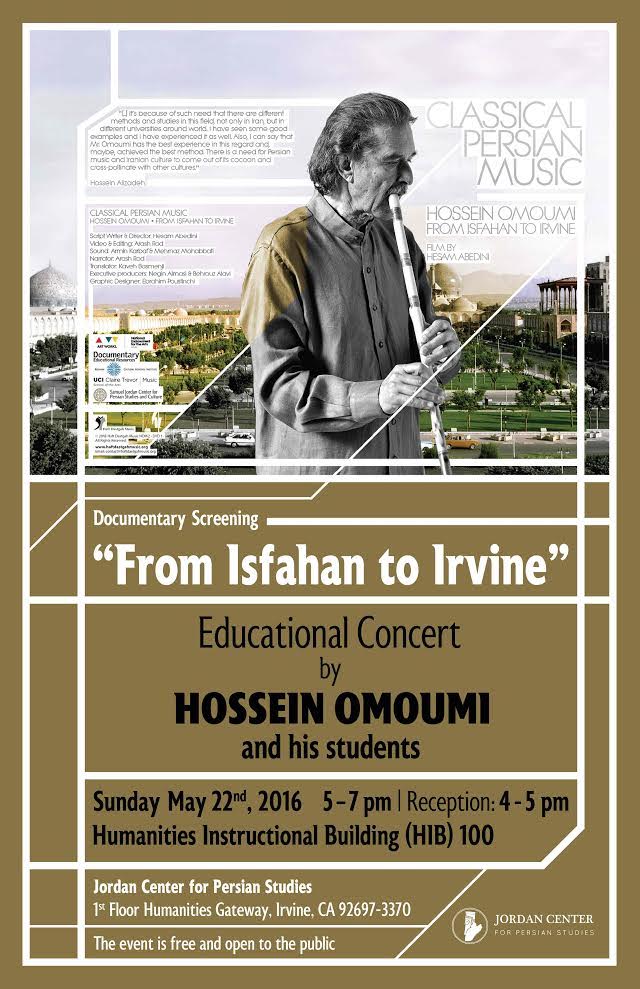
“Hossein Omoumi from Isfahan to Irvine” Film Screening and Educational Concert

The documentary film, “Classical Persian Music – Hossein Omoumi from Isfahan to Irvine”, was successfully premiered along with an educational concert by Professor Hossein Omoumi and his students on May 22, 2016, at the University of California Irvine. Funded in part with a grant from Roshan Cultural Heritage Institute, the documentary introduces the history and beauty of classical Persian music through Professor Hossein Omoumi’s innovations in education and musical technology. Dr. Omoumi, Maseeh Professor of Persian Performing Arts at the University of California, Irvine, is an internationally recognized musician, master of the Persian reed flute (ney), teacher and scholar. He has made it his life’s mission to provide global access to classical Persian music.

Following the success of the May premiere, with 250 in attendance, Professor Omoumi has been invited to bring the same program to the University of Maryland, College Park, on October 18; Swarthmore College on October 20; Oklahoma University on November 5; Oklahoma State University on November 6; and to London and Tehran the second half of November.

Watch the film trailer on YouTube

Court and Cosmos: The Great Age of the Seljuqs Exhibition at The Metropolitan Museum of Art

Opening April 27 at New York’s Metropolitan Museum of Art is Court and Cosmos: The Great Age of the Seljuqs, an international loan exhibition featuring spectacular works of art created under Seljuq rule, in the 11th through 13th centuries. The Seljuqs were a Turkic dynasty of Central Asian nomadic origin that established a vast, but relatively short-lived empire in West Asia (present-day Turkmenistan, Iran, Iraq, Syria, and Turkey). On display at this special MET exhibition will be approximately 270 objects -including luster painted ceramics, silk textiles, manuscripts, and ornate metalwork- on loan from American, European, and Middle Eastern public and private collections. Many of the institutions have never lent works from their collections before. Organized by Sheila Canby, the Patti Cadby Birch Curator in Charge, Department of Islamic Art, the exhibition runs from April 27 through July 24, 2016.

Exhibition programs include a performance on May 15 of Feathers of Fire, a cinematic shadow play adaptation of a tale from the Shahnama by artist Hamid Rahmanian. Also included is a scholarly symposium on June 9 through 11. Professors Robert and Carole Hillenbrand (Institute of Iranian Studies, University of St. Andrews) will deliver a joint keynote address on the historical context of Seljuq art, namely of the regions stretching from Merv to Mosul. Roshan Cultural Heritage Institute is proud to support both programs.

Find out more about Court and Cosmos at The MET

LOST ENLIGHTENMENT: Lecture and Book Signing by Dr. Fred Starr

Roshan Cultural Heritage Institute is pleased to announce Lost Enlightenment: Central Asia’s Golden Age from the Arab Conquest to Tamerlane, a lecture and book signing by Dr. Fred Starr, hosted by the Library of Congress and Roshan Institute for Persian Studies at University of Maryland, College Park.

Dr. Fred Starr is the founding Chairman of the Central Asia-Caucasus Institute and Silk Road Studies Program, a joint transatlantic research center affiliated with the Paul H. Nitze School of Advanced International Studies, Johns Hopkins University in Washington (where he is a Research Professor) and the Institute for Security and Development Policy in Stockholm.
The lecture is free and open to the public.

Thursday, May 5, 2016 | 12:00 p.m. – 1:00 p.m. | Thomas Jefferson Building, African Middle Eastern Reading Room, LJ-220 | Library of Congress

Find out more about the event

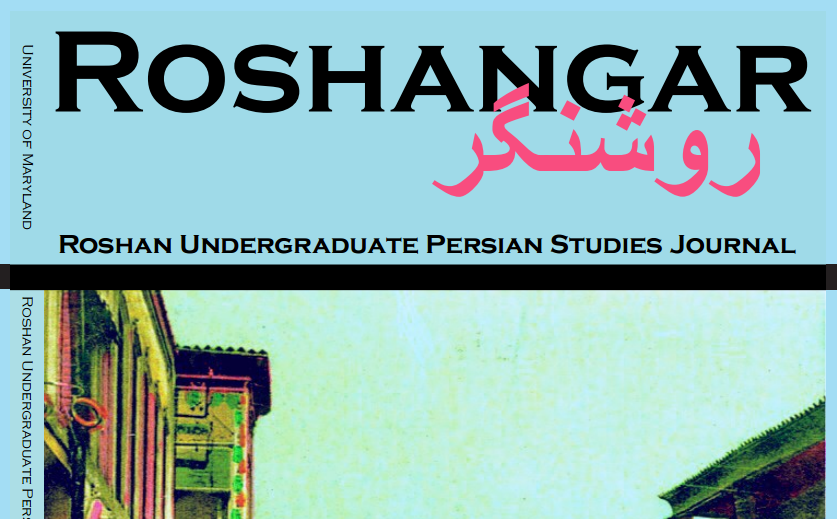
First Issue of Roshangar: the Undergraduate Persian Studies Journal at the University of Maryland

Roshan Cultural Heritage Institute is proud to announce the first issue of Roshangar, the undergraduate journal in Persian Studies at Roshan Institute for Persian Studies, University of Maryland. This biannual academic publication is totally designed and run by a group of talented undergraduate students, under the guidance of former Roshan Cultural Heritage Institute Fellow, Ida Meftahi, Visiting Assistant Professor at Roshan Institute for Persian Studies.

The electronic copy of this peer-reviewed journal is available on the Roshangar website, which also features film and book reviews, interviews with scholars and artists, as well as highlights of local Persian events.

The Finale in the Roshan Institute Lecture Series will recognize the outstanding contribution of UMD undergraduate students to Persian Studies and the launch of Roshangar.

Tuesday, May 3, 2016 | 5:00 p.m. – 6:30 p.m. | Roshan Institute for Persian Studies, Jmz1220 | University of Maryland College Park

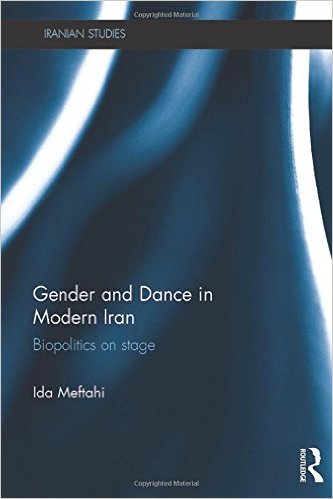
Publication of “Gender and Dance in Modern Iran: Biopolitics on Stage” (Routledge, 2016) by Dr. Ida Meftahi

Roshan Cultural Heritage Institute is delighted to announce the publication of Gender and Dance in Modern Iran: Biopolitics on Stage by Dr. Ida Meftahi, Visiting Assistant Professor in contemporary Iranian culture and society at Roshan Institute for Persian Studies, University of Maryland.

Gender and Dance in Modern Iran: Biopolitics on Stage investigates the ways dancing bodies have been providing evidence for competing representations of modernity, urbanism, and religiosity across the twentieth century.

Focusing on the transformation of the staged dancing body, its space of performance, and spectatorial cultural ideology, this book traces the dancing body in multiple milieus of performance, including the Pahlavi era’s national artistic scene and the popular café and cabaret stages, as well as the commercial cinematic screen and the post-revolutionary Islamized theatrical stage. Engaging with a range of methodological and historiographical methods, including postcolonial, performance, and feminist studies, this book is a valuable resource for students and scholars of Middle East history and Iranian studies, as well as gender studies and dance and performance studies.

Find more about Dr. Meftahi’s Book

New Roshan Graduate Interdisciplinary Program in Persian and Iranian Studies at the University of Arizona

Roshan Cultural Heritage Institute is delighted and proud to announce a new endowment to the University of Arizona to establish the Roshan Graduate Interdisciplinary Program in Persian and Iranian Studies at the Graduate School, and support the program’s components, including a new endowed faculty chair and an endowed professorship, the Master of Arts and doctoral programs that are currently under development, and programmatic activities.

This endowment is uniquely poised to make a real impact for the training of Persian and Iranian studies scholars and Persian language teachers, for generations to come. The endowment also marks the first Roshan Cultural Heritage Institute graduate program among its network of endowed programs in Persian Studies throughout the world.

Kamran Talattof, a professor in Middle Eastern and North African Studies, will hold the Roshan Institute Chair in Persian and Iranian Studies, and also will serve as the initial Director of the Roshan Graduate Interdisciplinary Program’s executive committee. The Roshan Institute Professor in Persian and Iranian Studies has yet to be named.

This is Roshan Cultural Heritage Institute’s second endowment to the University of Arizona. In 2003, an endowment for Roshan Institute Fellowship for Excellence in Persian Studies was established in the School of Middle Eastern and North African Studies. The two endowments combined bring Roshan Cultural Heritage Institute’s total gifts to $2.3 million in support of the renowned Persian and Iranian Studies program at the University of Arizona.

Read more about the Endowment at UA

Congratulations to Dr. Mohammad Gharipour on His Recognition as Emerging Scholar by Diverse Magazine

Roshan Cultural Heritage Institute would like to congratulate Dr. Mohammad Gharipour on his recent selection by Diverse: Issues In Higher Education as one of the twelve minority scholars who are making their mark in academia. Diverse magazine’s selection of Emerging Scholars is based on a number of factors, the most important being uniqueness of scholarship, commitment to teaching, community service, scholarly awards, honors, and academic accomplishments.

Dr. Gharipour, a tenured Associate Professor in the Morgan State University (MSU) School of Architecture and Planning, is a specialist of architectural and landscape history, and holds a Ph.D. from Georgia Institute of Technology. He has received recognition for his academic achievements from the Society of Architectural Historians, Morgan State University, and the National Endowment in Humanities, among others. Dr. Gharipour is the author of Persian Gardens and Pavilions: Reflections in Poetry, Arts and History (I.B. Tauris, 2013) and the Editor of several other books on Islamic architecture. He is also the Director and Founding Editor of the International Journal of Islamic Architecture, an interdisciplinary journal which focuses on detailed analysis of the practical, historical and theoretical aspects of architecture in the historic Islamic world, with a focus on both design and its reception.

Read Diverse’s article on Dr. Gharipour

“Classical Persian Music – Hossein Omoumi from Isfahan to Irvine” Documentary

Roshan Cultural Heritage Institute is proud to announce the completion of the documentary film, Classical Persian Music – Hossein Omoumi from Isfahan to Irvine,” which introduces the history and beauty of classical Persian music through Professor Hossein Omoumi’s innovations in education and musical technology. Dr. Omoumi, Maseeh Professor of Persian Performing Arts at the University of California, Irvine, is an internationally recognized musician, master of the Persian reed flute (ney), teacher and scholar. He has made it his life’s mission to provide global access to classical Persian music.

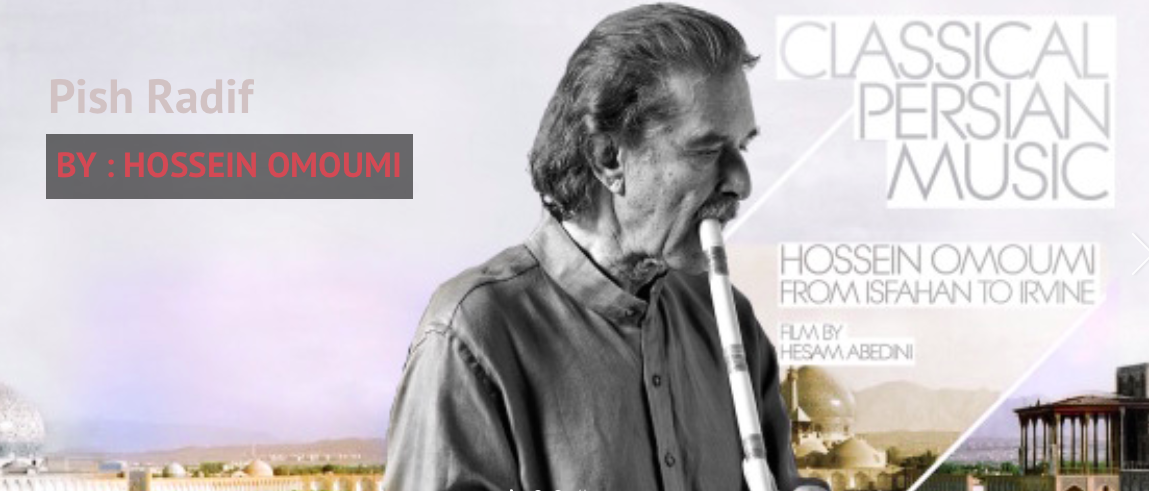
The film engages a diverse audience, following the life of Professor Omoumi while also providing insight into Persian music itself. The film also briefly presents a series of eleven lessons called “Pish-Radif” (Pre-Radif or overture to Radif) created by Professor Omoumi that are designed to introduce students to the main musical structures of classical Persian music systems in a short time by working on eleven of the twelve complex systems in Radif. Those interested in knowing more about the history and structure of classical Persian music and poetry and their relation to one another and learning the Pish-Radif may refer to the website and the iBook of Pish-Radif.

Find more about Pish-Radif

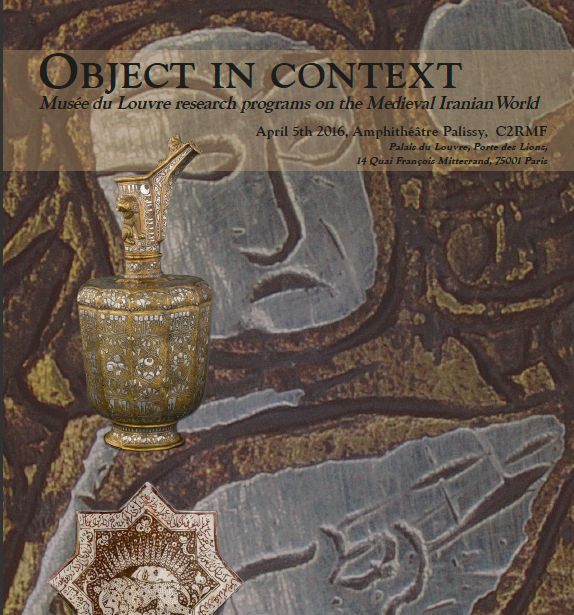
Object in Context: Louvre Museum Research Programs on the Medieval Iranian World

Roshan Cultural Heritage Institute is proud to announce “Object in Context” at the Louvre Museum on April 5, 2016, from 9am to 5pm.

This day-long program will present the first results of two major research programs focusing on metal wares and metallic lustre wares from the Medieval Iranian World: Islametal and Medieval Kashi projects, both proudly funded by the Elahé Omidyar Mir-Djalali Fund at the Louvre.

Islametal concerns the understanding of materials, techniques and gesture of creation that led to the production of metal wares in the Great Iranian World ( c.10th-15th centuries). One of its main goals is to find out how, where, for whom and in which production context those objects were made. The project is led by Annabelle Collinet from the Department of Islamic Art at the Louvre, with the assistance of Vana Orfanou, the second Elahé Omidyar Mir-Djalali Fellow at the Louvre.

The Medieval Kâshi project focuses on Medieval Iranian tiles from the 13th–14th centuries. Their contextualization is based on the survey of main collections of Iranian lustre tiles in Iran, Europe, and the United States. This project is co-led by Delphine Miroudot from the Department of Islamic Art at the Louvre and Dr. Maryam Kolbadinejad from the Islamic Azad University in Tehran.