EWC Education Program Presents: Iran, The Turquoise Bridge to Civilization

In this special panel discussion, two Persian scholars will guide the audience through a fascinating exploration of one of the world’s oldest and most prolific cultures, and its many important and enduring contributions to humanity.

Professor Hamedani’s presentation, Persian Poetry and Its Influence on Iranian Life, will delve deep into the richness of Persian poetry, the most significant part of Persian literature, renowned for its magnificent use of beautiful language composed mostly in rhythmic rhymes. Divine love is at the center of the spiritual content in Persian poetry, a reflection of the great impact that Iranian mysticism has had on it. Reading Persian poetry is very much common among Iranians today, indicating the extent of its interweaving with Iranian culture.

Professor Parsa’s presentation, Ancient Persia/Iran and Its Cultural Contributions to the World: From Mithra to Manes, will highlight the historic backdrop for Persian influence on world civilizations, covering the cultural, religious and spiritual contributions of Ancient Persia from 1000 BC to 1000 AD. Ancient Persian prophets and spiritual teachers Mithra, Zoroaster, Manes, and Mazdak will be presented and discussed.

Wednesday, February 18, 2015 | 6:30 – 8:30 p.m. | Wailana Room, Imin International Conference Center
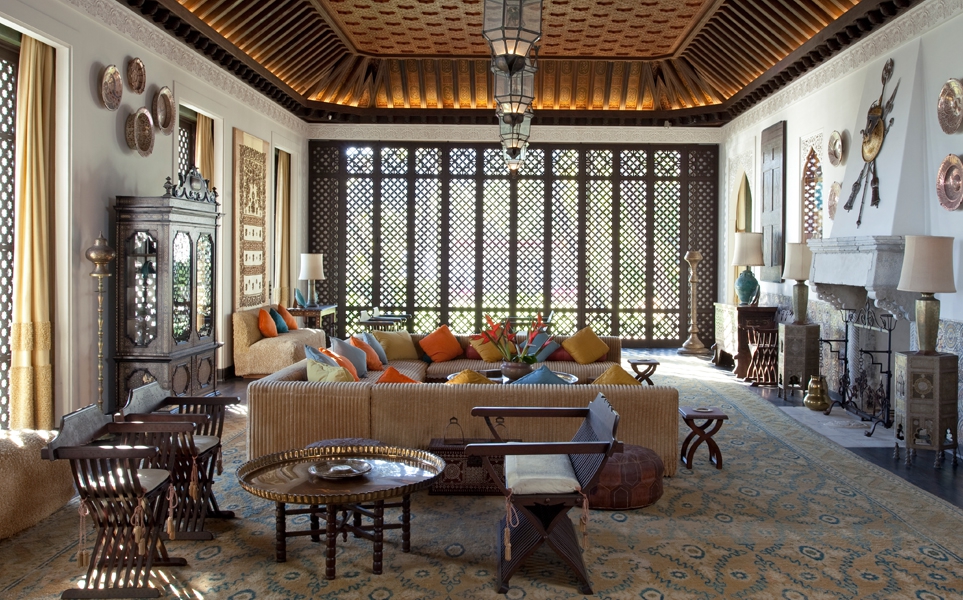

Traveling Exhibition “Doris Duke’s Shangri La: Architecture, Landscape, and Islamic Art” Will Conclude Its Tour at the Honolulu Museum of Art, February 12 – June 7, 2015

“Doris Duke’s Shangri La: Architecture, Landscape, and Islamic Art” showcases objects of Islamic art from the spectacular Honolulu home of philanthropist and art collector Doris Duke (1912-1993) and also includes new works by eight contemporary artists of Islamic background, all of whom have participated in Shangri La’s artist in residency program.

The works from Duke’s personal collection are being shown outside of Shangri La for the first time, in an exhibition that was organized on the centenary of her birth. After travelling nationally for two years, the show ends its journey in the objects’ “home”—Honolulu. Highlights include ceramic vessels and tiles from 11th–20th century Iran; inlaid wood and furniture from Spain, Syria, Iran, and India; Egyptian and Ottoman textiles; and jewelry from Mughal India. Large-scale, newly commissioned photographs by Tim Street-Porter establish the context of the legendary five-acre property of Shangri La. The contemporary works in the exhibition are by Ayad Alkadhi, Zakariya Amataya, Afruz Amighi, Shezad Dawood, Emre Hüner, Walid Raad, Shahzia Sikander and Mohamed Zakariya.


Persian Music and Poetry Events at Roshan Institute for Persian Studies, University of Maryland

Roshan Institute for Persian Studies at the University of Maryland is concluding its Fall 2014 public program with two cultural events in early December. On December 3, Shahla Nikfal and Bahram Sadeghian will give a special performance of classical Persian music entitled “Persian Music Event: Ghanoon, Daf & Vocal Performance.” On December 5, Shefalika Gandhi (Princeton University) will present a lecture on the “Use of Rumi poetry in modern mindfulness practices.” This presentation will include readings of Rumi’s poetry, which captures the mechanisms of mindfulness with a profound simplicity, and reaches across cultures to highlight our shared human experiences.

Continued Progress on the Persepolis Fortification Archive Project During Summer 2014

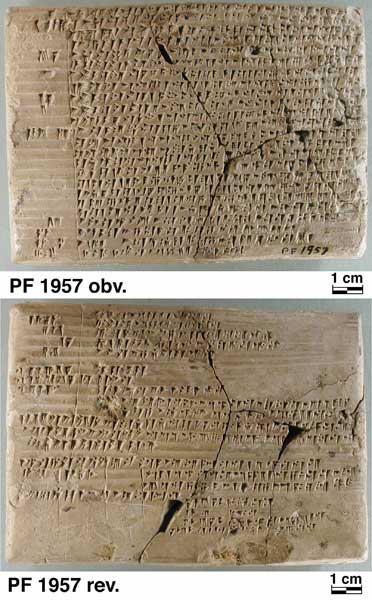
Roshan Cultural Heritage Institute would like to commend Dr. Matthew Stolper (John A. Wilson Professor Emeritus of Oriental Studies, The University of Chicago), Dr. Mark Garrison (Alice Pratt Brown Professor of Art and Art History, Trinity University), and students Christina Chandler and Erin Daly, for their excellent work on the Persepolis Fortification Archive (PFA) Project during summer 2014. This initiative has been supported by Roshan Institute since 2013.

Under the supervision of Professor Stolper, Director, PFA Project, and Professor Garrison, PFA Project Editor, Ms. Chandler and Ms. Daly recorded and documented seal impressions on tablets discovered at Persepolis. Their work is crucial to the study of Elamite and Aramaic texts inscribed on these tablets, and contribute to advancing scholarship in Persian Achaemenid studies. In addition, both students earned valuable first-hand experience with important artifacts and plan to pursue their work in the PFA Project and in Persian Studies. Ms. Chandler is currently a first year Ph.D. candidate in Classical and Near Eastern Archaeology at Bryn Mawr College and Ms. Daly began the Ph.D. program in Classics at The University of Chicago.

Learn more about the Persepolis Fortification Archive Project

Roshan Institute Fellowships in Persian Language, Linguistics, and Culture at the University of Hawaii at Manoa

Roshan Cultural Heritage Institute is delighted to announce that several fellowships are available to graduate students pursuing Persian Studies at the University of Hawaii at Manoa.

One Roshan Institute Fellowship in Persian Linguistics, Language Acquisition and Applied Linguistics will support a qualified student admitted to a doctoral program in Linguistics or in Second Language Studies at the College of Languages, Linguistics, and Literature in 2015-2016. This annual fellowship is renewable for up to three years. Several Roshan Institute Fellowships for Persian Language and Culture will be awarded in spring 2015 to graduate students taking Persian language and culture courses offered by the Persian Language, Linguistics, and Culture Program.

UCLA Offers Postdoctoral Fellowship and Conferences in Persian Language in 2015-2016

UCLA Center for 17th- & 18th- Century Studies announced that its Ahmanson-Getty Postdoctoral Fellowship program will focus on “The Frontiers of Persian Learning: Testing the Limits of a Eurasian Lingua Franca, 1600–1900” in 2015-2016. The theme-based resident fellowship program, established with the support of the Ahmanson Foundation and the J. Paul Getty Trust, is designed to encourage the participation of junior scholars in the Center’s yearlong core programs.

The 2015-2016 program will include conferences on “The Geographical Frontiers of Persian Learning” (October 16, 2015), “The Social Frontiers of Persian Learning” (February 5, 2016), and “The Epistemological Frontiers of Persian Learning” (April 8–9, 2016).

Roshan Institute Lecture Series on “Book of Kings, The Shahnameh” by Iraj Tabibnia at San Jose State University, September 6 – December 6, 2014

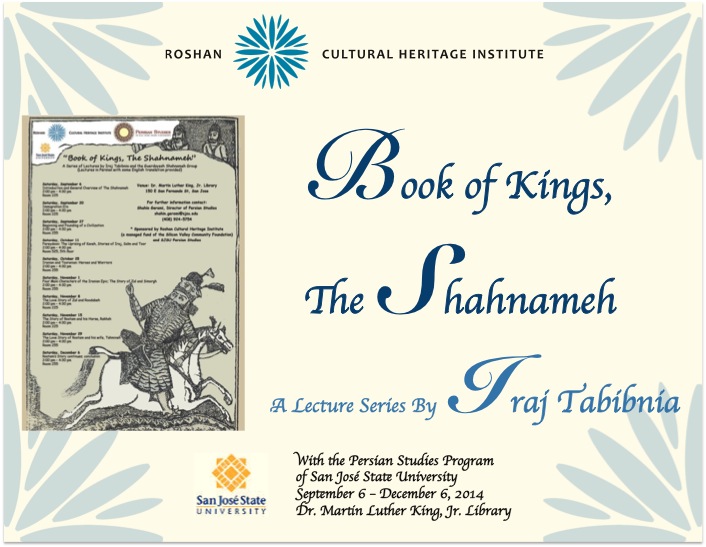
Roshan Cultural Heritage Institute is delighted to present a wonderful lecture series on the Book of Kings (Shahnameh) by Iraj Tabibnia from September 6 – December 6. The Book of Kings is a literary masterpiece written by the Persian poet Firdawsi ca. 1010 A.D. and narrates the myths, legends and history of Iran from its beginning to the Arab conquest in 7th century A.D. Through lively readings, discussions and slideshows, Mr. Tabibnia will bring this epic story and its characters – kings, heroes, villains and supernatural creatures – to life. Ten lectures in Persian with summary English translation will take place at the Martin Luther King Jr. Library of San Jose State University.

Mr. Tabibnia is an independent researcher in Persian history and literature who has studied and lectured extensively on The Book of Kings. He is the author of the book, The Story of the Compact of Rostam and Sohrab, as well as of several articles on the same subject. For more information on the lecture series, please contact Iraj Tabibnia (itabibnia@yahoo.com).

See the full schedule

Exhibition and Lecture on Nasta’liq at Freer and Sackler Galleries and University of Maryland

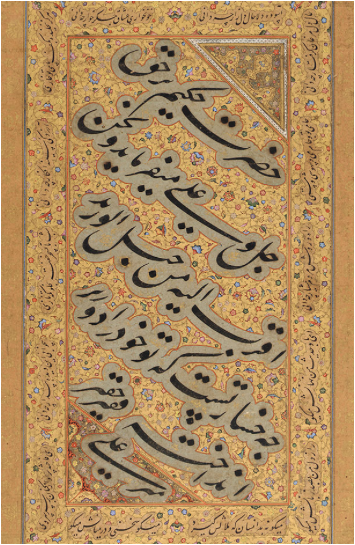
Currently on display at the Arthur M. Sackler Gallery of the Smithsonian Institution is a beautiful exhibition dedicated to Persian calligraphy. Entitled “Nasta‘liq: The Genius of Persian Calligraphy,” it focuses on nasta‛liq, a calligraphic script that developed in the fourteenth century in Iran and remains one of the most expressive forms of aesthetic refinement in Persian culture to this day. The exhibition is curated by Dr. Simon Rettig, Freer and Sackler Galleries Curatorial Fellow for the Arts of the Islamic World, and is on view through March 22, 2015.

On November 17, Dr. Rettig will present a lecture on the topic of “When the genius lies elsewhere: Mir ‘Ali Tabrizi and the “invention” of the nasta’liq script” at Roshan Institute for Persian Studies at the University of Maryland. Mir ‘Ali Tabrizi – the alleged inventor of nasta‘liq, Sultan Ali Mashhadi, Mir Ali Haravi, and Mir Imad Hasani were four of the greatest master calligraphers.

For more information on the exhibition

Brown University’s 2014 Visiting Scholar Mohsen Namjoo Celebrates Iranian Music in November

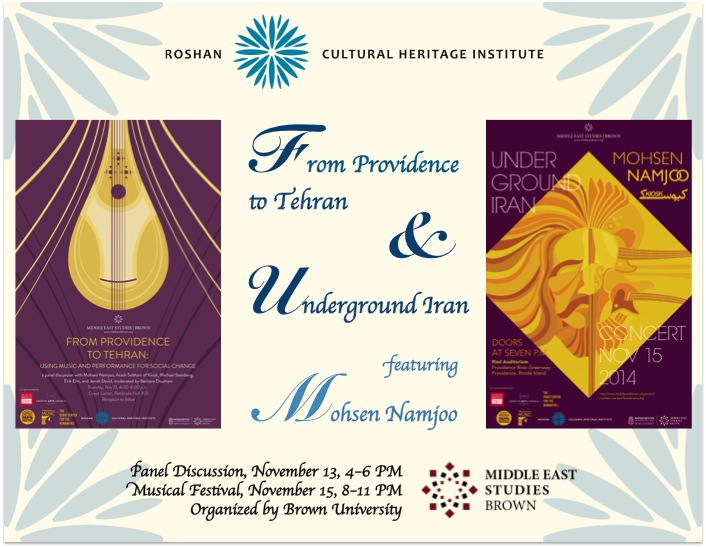
Roshan Cultural Heritage Institute is delighted to support the 2014 residency of Visiting Scholar Mohsen Namjoo in the Middle East Studies program at Brown University. Namjoo is an acclaimed Iranian artist, songwriter, singer, music scholar and setar player. During his time at Brown, he engaged in a number of activities including courses on Persian music, musical talks, and concerts.

Namjoo’s residency is culminating in “Underground Iran,” a musical festival featuring Namjoo and KIOSK, another Iranian group, on stage for the first time, on November 15. It will be preceded on November 13 by “From Providence to Tehran: Using Music and Performance for Social Change,” a panel discussion with Mohsen Namjoo, Arash Sobhani (KIOSK) and Brown faculty, and moderated by Professor Beshara Doumani, Director of Middle East Studies.

“Empire as a Garden” by Prof. Touraj Daryaee and Other Events at the University of Washington

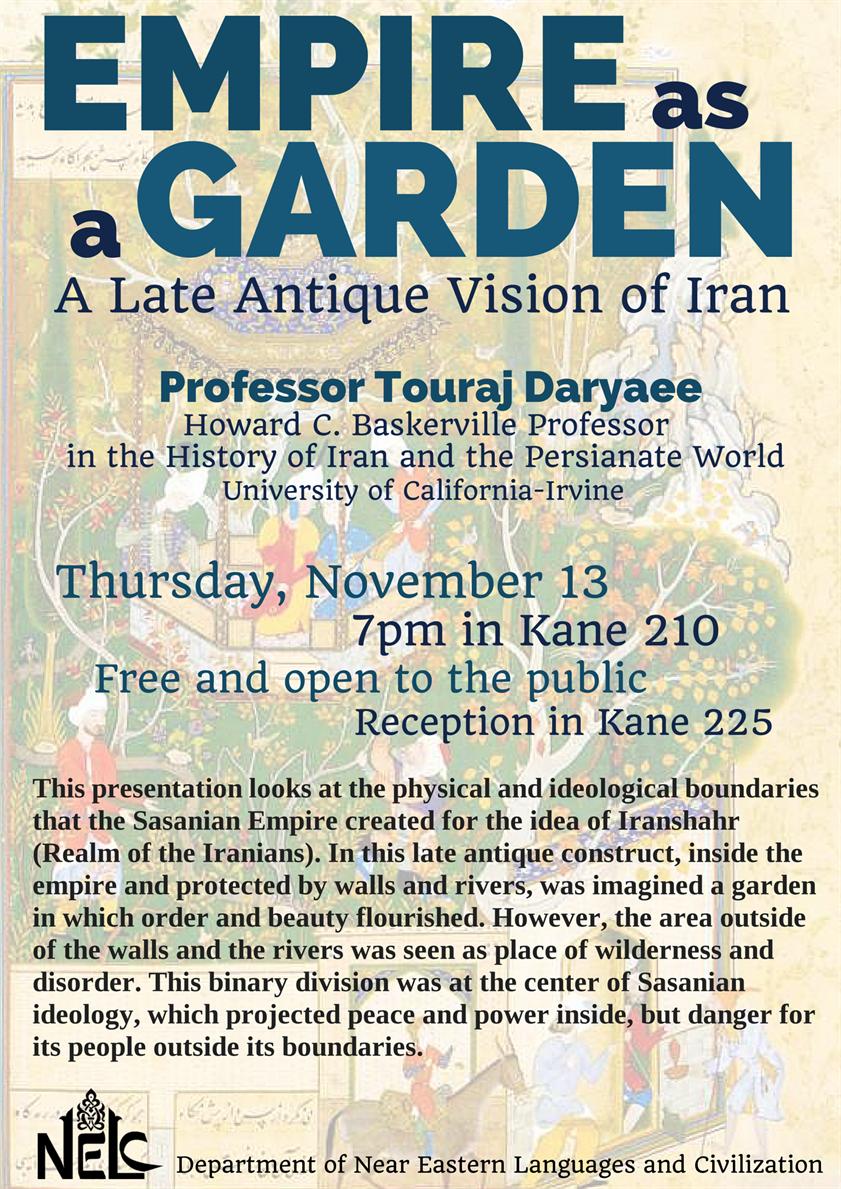
On November 13, the University of Washington’s Department of Near Eastern Languages and Civilization and Persian and Iranian Studies Program will welcome Professor Touraj Daryaee (UC Irvine) for his lecture “Empire as a Garden: A Late Antique Vision of Iran”. This presentation looks at the physical and ideological boundaries that the Sasanian Empire created for the idea of Iranshahr (Realm of the Iranians). In this late antique construct, inside the empire and protected by walls and rivers, was imagined a garden in which order and beauty flourished. However, the area outside of the walls and the rivers was seen as place of wilderness and disorder. This binary division was at the center of Sasanian ideology, which projected peace and power inside, but danger for its people outside its boundaries.

The Persian and Iranian Studies Program will also hold several Persian Studies Workshops this year, featuring Professor Kenneth Harl (Tulane University), Professors Naghmeh Samini and Farhad Atai (University of Tehran), and UW’s 2013-2014 Roshan Institute Fellow, Jipar Duishembieva. They will discuss subjects ranging from Iranian archaeology to theater and poetry.