Translating Islam: A Conference in Honor of Carl Ernst, October 6-7, 2017, at the University of North Carolina at Chapel Hill

Roshan Cultural Heritage Institute is pleased to announce the two-day conference, “Translating Islam: A Conference in Honor of Carl Ernst,” that will take place on October 6-7, 2017, at UNC Chapel Hill. Carl W. Ernst is the William R. Kenan, Jr., Distinguished Professor of Islamic studies at the Department of Religious Studies and Director of the Persian Studies program at the University of North Carolina at Chapel Hill. He has devoted his academic life to the study of three areas: general and critical issues of Islamic studies, pre-modern and contemporary Sufism, and Indo-Muslim culture. From his first book, Words of Ecstasy in Sufism (1985), to his most recent book, co-edited with Fabrizio Speziale, Perso-Indica: An Analytical Survey of Persian Works on Indian Learned Traditions (2017), he has focused on how Islamic concepts have traveled across time and space.

This conference, organized around themes in Islamic studies that Professor Ernst’s work has addressed, evokes and expands on the major contributions of this fertile, creative translator of texts, ideas, and traditions within the orb of Islam. Topics of the panels include: Islam at large, Indo-Muslim ventures, Translations issues, Sufi studies, and Islamic studies. A Persian Classical Music concert by the Rohab Ensemble will take place on Friday night, at the UNC Stone Center Auditorium. The Rohab Ensemble brings three acclaimed maestros from the celebrated Dastan Ensemble – Hossein Behroozinia (barbat – lute), Saeed Farajpoori (kamancheh – spike fiddle), and Behnam Samani (tombak – goblet drum), together with Hamid Behrouzinia (tar – lute) and will be accompanied by the lilting voice of Sepideh Raissadat (Roshan Institute Fellow, 2016).

Organized by the Duke-UNC Consortium for Middle East, the conference is free and open to the public; however, registration is requested.
Find more about the Conference

New Elahé Omidyar Mir-Djalali Presidential Chair in Art History and Archaeology of Ancient Iran at the University of California, Irvine

Roshan Cultural Heritage Institute is delighted to announce its first endowment to the University of California, Irvine (UCI) for the establishment −with additional funding from the UC Regents’ Presidential Matching Chairs Fund− of a new Elahé Omidyar Mir-Djalali Presidential Chair in Art History and Archaeology of Ancient Iran at the School of Humanities.

The new Elahé Omidyar Mir-Djalali Presidential Chair in Art History and Archaeology of Ancient Iran will have expertise in the three dynasties of the ancient Persian world: Achaemenid, Arsacid and Sasanian (550 BCE-650 CE). The new Chair will enhance the robust study of the ancient world pursued by a number of departments in the School of Humanities, including History, Classics, and Persian and Iranian Studies. In addition to teaching, the new scholar will conduct extensive research, author publications, and hold or participate in scholarly conferences and related events.

The new faculty member will report to both the Dean of School of Humanities and the Chair of the Department of Art History, and will collaborate with the UCI Samuel M. Jordan Center for Persian Studies and Culture. Founded in 2009, the UCI Jordan Center is a hub for interdisciplinary research projects that bridge the arts, humanities, engineering, medicine, and the sciences with Persian studies. Students can minor in Persian Studies and take courses in both ancient and modern Iran.

Recruitment for the inaugural chair holder is planned for the coming 2017-2018 academic year. Roshan Cultural Heritage Institute is proud to partner with UCI, relying on its excellence in academic strength and knowing that this endowment will benefit generations of faculty and students pursuing Persian and Iranian Studies.

Read the press release

Learn more about UCI School of Humanities

Congratulations to Dr. Anousha Sedighi on her Promotion to the Rank of Full Professor at Portland State University

Roshan Cultural Heritage Institute would like to congratulate Dr. Anousha Sedighi on her appointment to the rank of Full Professor of Persian and Head of the Persian program at Portland State University in Oregon. Dr. Sedighi founded the Persian program in 2005 and launched the Persian minor, the only minor in the state of Oregon, in 2011. Dr. Sedighi’s areas of research are Persian linguistics, Persian language pedagogy, and Persian as a heritage language. She has published two books, Agreement Restrictions in Persian (Rozenberg & Purdue, 2008), which was re-published in 2011 by Leiden University and the University of Chicago Press, and Persian in Use: An Elementary Textbook of Language and Culture (Leiden University, 2015) for which she received a Roshan Institute Fellowship for Excellence in Persian Studies in 2010.

Persian in Use is an elementary Persian language and culture textbook designed for first-year Persian language students at the college level. It offers a thematically organized and integrative approach to help students achieve proficiency in Persian language and culture. This publication is organized around high-frequency topics and provides a clear set of communication goals for each lesson.

Persian in Use has been re-published for the fourth time since 2015 due to popular demand and is currently used at more than 20 universities in the U.S. as well as internationally in Germany, Italy, the Netherlands and Canada.

Find more about Persian in Use

Congratulations to 2017-2018 Elahé Omidyar Mir-Djalali Fellows at UC Irvine

Two UCI Ph.D. students, Deanna Kashani and Soodabeh Malekzadeh, have each been awarded the Elahé Omidyar Mir-Djalali Fellowship for Excellence in Persian Studies for the completion of their doctoral degrees during academic year 2017-2018.

Ms. Kashani is a Ph.D. candidate in Visual Studies. Her dissertation, entitled “Beyond the Framed Image: Contemporary Iranian Art from Production to Exhibition,” is the first comprehensive study of contemporary Iranian art exhibition structures inside Iran in English. She compares institutionalized, underground, and public art exhibition spaces within Iran to demonstrate how these sites and their agendas influence the production and propagation of art and art historical knowledge. Through the use of art historical and ethnographic methodologies and a diverse set of exhibition case studies, she reveals that the Iranian art world is trying to define itself and its future as experimental, autonomous, and connected with the interests of the local community.

A Ph.D. candidate in History, Ms. Malekzadeh focuses her interests on ancient Persia. Her dissertation, “Bahram V: The Romantic Hunter-King or a Judeo-Arab Emperor?” centers on the history of the Sasanian empire during the early fifth century using a biographical lens that reexamines the life and legacy of Bahram V and his father Yazdegird I. The reign of Bahram V is only mentioned in passing in monographs that cover a general history of the Sasanian Empire. Malekzadeh’s dissertation fills this gap by providing a comprehensive research on the biography of Bahram V, his legacy in art and literature, and finally, the role of his historical depiction in modern national propaganda. Her study promises to be useful to scholars interested in the history of the Sasanian period, as well as the political, and social history of early fifth-century Persia.

Read the press release

Elahé Omidyar Mir-Djalali Fellowship Awarded by the Louvre Museum

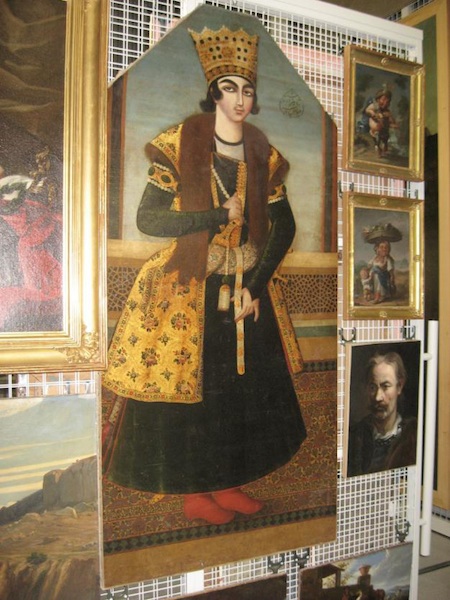
Roshan Cultural Heritage Institute would like to welcome Mrs. Carol Guillaume to the Louvre where she will assist Mrs. Gwenaëlle Fellinger, Curator in the Department of Islamic Art, with the organization of a major international exhibition on Qajar Art in 2018. Though French museums are rich in art from the Qajar period (1781 to 1925), most Iranian collections are not well known to the public. To remedy to this gap, Mrs. Fellinger has been conducting since 2012 an in-depth study of the Qajar collections kept in regional museums of France. Her study will culminate, with the assistance of our Fellow, to a major exhibition that will bring to light nearly 500 unpublished artworks preserved in national and private collections.

The Qajar Art Exhibition will run from March 28 to July 22, 2017, at the annex of the Louvre Museum in Lens, North of France. Along with the exhibition and its accompanying catalogue, Mrs. Fellinger and Guillaume will organize an international colloquium on Qajar Art in June 2018 at Louvre-Lens. The two-day colloquium will enable scholars to study specific subjects that cannot be explained in depth in the exhibition nor in the catalogue. Papers from the colloquium will be published in 2019.

Mrs. Guillaume is a graduate of the Ecole du Louvre, where she specialized in Art History with an emphasis on Qajar collections.
Her fellowship period is from September 2017 to August 2018.

Find more about the Department of Islamic Art at the Louvre

Roshan Institute Fellows and Recent Accomplishments

Roshan Cultural Heritage Institute is delighted to share news about some of its Fellows and their recent accomplishments.

Nicholas Boylston obtained his Ph.D. in Theological and Religious Studies from Georgetown University. His area of specialization is Persian literature and Islamic intellectual history through the lenses of religious, intellectual and literary pluralism, and he wrote his dissertation on “Writing the Kaleidoscope of Reality, the Significance of Diversity in 6th-12th century Persian Metaphysical Literature: Sana’i, ‘Attar and ‘Ayn al-Qudat Hamadani.” Dr. Boylston is currently Lecturer (half-time) in the Committee on the Study of Religion, Visiting Postdoctoral Fellow at the Center for Middle Eastern Studies, and Visiting Fellow at the Center for the Study of World Religions, at Harvard University.

Safoura Nourbakhsh successfully defended her dissertation on “Expressions of Gender and Sexuality in Persian Sufism” and completed her Ph.D. in Women’s Studies from the University of Maryland (UMD). Dr. Nourbakhsh is the Project Manager of the Persian translation and adaptation of Our Bodies, Ourselves, a digital interactive project hosted by UMD.

Vahideh Rasekhi (Linguistics, Stony Brook University) and Tytus Mikolajczak (Near Eastern Languages and Civilizations, The University of Chicago) are also making progress toward the completion of their doctoral dissertations.

Roshan Cultural Heritage Institute would like to commend all Fellows for their contributions to Persian Studies scholarship and wishes them continued success.

New Grant to hold annual Elahé Omidyar Mir-Djalali Symposia and Lectures at UCI Jordan Center for Persian Studies and Culture

Roshan Cultural Heritage Institute is delighted to announce a new grant to hold three annual programs at the UCI Jordan Center for Persian Studies and Culture, under the leadership of Professor Touraj Daryaee, UCI Maseeh Chair in Persian Studies and Culture. Professor Daryaee, in collaboration with the new Elahé Omidyar Mir-Djalali Presidential Chair in Art History and Archaeology of Ancient Iran, will organize the annual Elahé Omidyar Mir-Djalali Symposium on Ancient Iranian History and Civilization; while Nasrin Rahimieh, UCI Howard Baskerville Professor of Humanities, will organize the annual Elahé Omidyar Mir-Djalali Symposium on Persian Language and Literature. The first symposium is planned for the fall quarter 2017, and the second symposium will be held in the spring quarter 2018. In conjunction with each symposium, the senior scholar will give a public Elahé Omidyar Mir-Djalali Lecture, which will be open to the Orange County community. The lectures will be recorded and available online.

Professor Daryaee is a specialist in Iranian history, in particular the Sasanian Empire, and has been teaching in the Department of History at UCI since 2007. In 2015, he was appointed Director of the UCI Jordan Center for Persian Studies and Culture, which serves as a hub for interdisciplinary research projects that bridge the arts, humanities, engineering, medicine, and the sciences with Persian studies. Since its inception in 2009, the center has hosted numerous conferences on the Iranian world, established research clusters uniting scholars on the study of the Tehran Project, alternative music, the Digital Archive of Middle Persian Inscriptions, and Sasanika (Late Antique Iran Project) and established an online peer-reviewed Journal, DABIR, dedicated to the study of Iran and related material.

Read more about UCI Jordan Center

Great Fall 2017 Courses offered by the Persian Program at the University of Arizona

Roshan Institute Chair in Persian and Iranian Studies, Kamran Talattof, recently announced the full line-up of fall semester courses at the University of Arizona. Elementary, intermediate and advanced Persian language will be offered as well as courses in Persian media, Persian fiction, Iranian cinema, and Persian Literature.

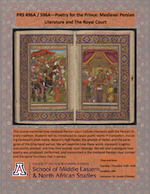
A new course, “Poetry for the Prince: Medieval Persian Literature and the Royal Court,” will be taught by Dr. Austin O’Malley, the new Roshan Institute Assistant Professor in Persian and Iranian Studies at the Roshan Graduate Interdisciplinary Program in Persian and Iranian Studies (Roshan GIDP). The course will investigate literary representations of kingship, explore the function of poetry in Medieval Iranian court settings, and study literary and courtly practices in historical context. It is open to both undergraduate and graduate students.

Students can have a minor in Persian by taking 18 units of these or other courses offered in upcoming semesters at the University of Arizona. The Roshan GIDP also offers M.A. and Ph.D. programs in Persian and Iranian Studies.

Learn more about Poetry for the Prince course

Learn more about Roshan GIDP

Congratulations to 2017-2018 Elahé Omidyar Mir-Djalali Fellow at UCLA

Naveed Mansoori has been awarded the Elahé Omidyar Mir-Djalali Fellowship for Excellence in Persian Studies for the completion of his dissertation during academic year 2017-2018. Mr. Mansoori is a Ph.D. student in Political Science at UCLA. His dissertation entitled, “In Medias Res: Media, Representation, and Authority in Iran, 1941-2009,” focuses on a varied but unified group of writers -Sadeq Hedayat, Ali Shariati and Ahmad Fardid (1909-1994)– who all envisaged their projects as the creation, or recreation, of an Iran which possessed an authentic, Islamic (Shi’a) identity. Mr. Mansoori is expected to defend his dissertation in June 2018.

Established in UCLA Division of Humanities, the Elahé Omidyar Mir-Djalali Fellowship for Excellence in Persian Studies is intended to support one graduate student each year from across the humanities or social sciences who has an approved dissertation topic focusing on Persian studies.

Learn more about the Elahé Omidyar Mir-Djalali Fellowship at UCLA

Video of the Library of Congress Symposium “From Oxus to Euphrates: The Sasanian Empire” available online

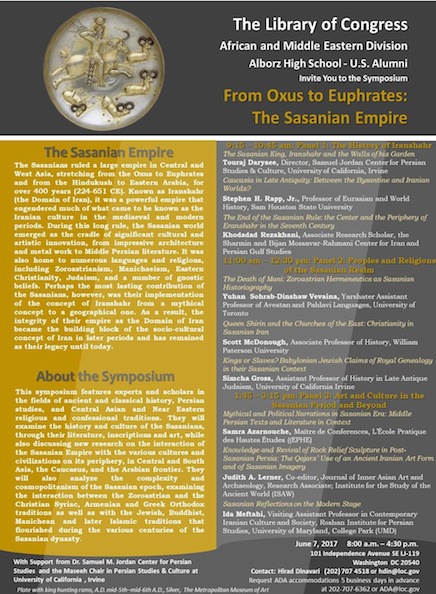
The African and Middle Eastern Division at the Library of Congress (AMED), in cooperation with the Iranian-American Alumni of the Alborz High School, presented “From Oxus to Euphrates: The Sasanian Empire,” a day-long symposium open to the public, on June 7, 2017. The event was part of an annual series of symposia on the ancient civilizations of the Near East organized by AMED at the Library of Congress. The video of the entire symposium is now available on the Library’s webcast page and on YouTube.

The Sasanians ruled a large empire in Central and Western Asia, stretching from the Oxus River to the Euphrates and from the Hindukush to Eastern Arabia, for over 400 years (224-651 CE). Known as Iranshahr (the Domain of Iran), it was a powerful empire that engendered much of what came to be known as the Iranian culture in the medieval and modern periods.

The Symposium featured three panels of experts and scholars in the fields of ancient and classical history, Persian studies, and Central Asian and Near Eastern religious and confessional traditions. Hirad Dinavari, Library of Congress Iranic world reference specialist, moderated one of the three panels along with Mary-Jane Deeb, chief of AMED and Professor Fatemeh Keshavarz, Roshan Institute Chair and Director of Roshan Institute for Persian Studies, at the University of Maryland School of Languages, Literatures and Cultures.

Panel One focused on the history of Iranshahr, with presentations by Roshan Institute Fellow, Dr. Touraj Daryaee, University of California, Irvine; Dr. Stephen H. Rapp Jr., Sam Houston State University; and Dr. Khodadad Rezakhani, Princeton University. Panel Two was on Peoples and Religions of the Sasanian Realm, and included presentations by Dr. Yuhan Sohrab-Dinshaw Vevaina, University of Toronto; Dr. Scott McDonough, William Paterson University; and Dr. Simcha Gross, University of California, Irvine. Panel Three focused on the art and culture in the Sasanian period and beyond, with presentations by Dr. Samra Elodie Azarnouche, Ecole Pratique des Hautes Etudes; Dr. Judith A. Lerner, Institute for the Study of the Ancient World; and Roshan Institute Fellow, Dr. Ida Meftahi, Roshan Institute for Persian Studies, University of Maryland.

View the video of the Symposium on the Library of Congress webcast page

View the video of the Symposium on YouTube