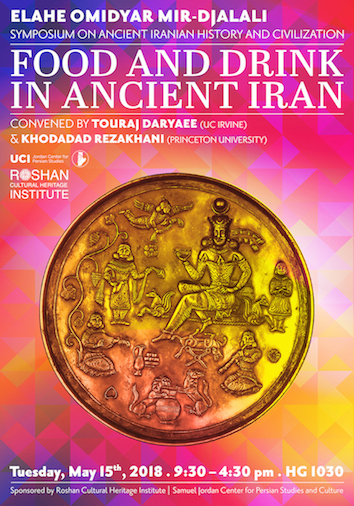
Elahé Omidyar Mir-Djalali Symposium on Ancient Iranian History and Civilization: Food and Drink in Ancient Iran at UC Irvine, May 15, 2018

Roshan Cultural Heritage Institute is delighted to sponsor the all-day conference, titled The Elahé Omidyar Mir-Djalali Symposium on Ancient iranian History and Civilization: Food and Drink in Ancient Iran, that is taking place on Tuesday, May 15, 2018, 9:30 am – 5:30 pm, in UC Irvine’s Humanities Gateway (HG) 1030.

This event is organized by Professor Touraj Daryaee, Director of UCI Jordan Center for Persian Studies & Culture, and Dr. Khodadad Rezakhani, Associate Research Scholar at Princeton University. The conference features two keynote addresses on the “Highlights of Ancient Persian Winemaking” and “What We Know about Medieval Persian Cuisine.” Following the conference, invited guests will be able to attend a reception, where a selection of food and desert from the Achaemenid to the Sasanian Period will be served, as well as contemporary Persian wine with Ancient Persian foods.

The day conference is free and open to the public. No registration is required.

The reception is by invitation only.

Find out more about UCI Jordan Center

Noruz Mobarak from Roshan Cultural Heritage Institute!

This most cherished Persian celebration goes back at least 3000 years and is about “Celebrating Life renewal in health and harmony with nature”

Noruz – literally “New Day” – is the Persian New Year and symbolizes renewal and rebirth. Noruz starts at the exact instant of the Vernal Equinox, which occurs each year around the 21st of March, the first day of spring. This most important Iranian holiday is a time for family and friends to gather together and is marked with a myriad of activities affecting everything from preparations and celebrations to food, clothing, gift giving, charity, and many other social and family activities.

Haftsin (Haft Seen) is the spread, around which the Family gathers to celebrate Noruz. Iranians take pride in putting together an attractive and elaborate spread to represent both spiritual and worldly symbols promising a happy start of the New Year. The Persian word Haft means seven and Sin refers to the sound /S/ in the language. Usually a nice embroidered fabric is used as the foundation of the spread. On the spread seven specific items starting with the sound /S/ are displayed. The set is prepared a day or two before Noruz and given a place of honor in the house to remain 13 days following Noruz. Additional items are also placed on the Haftsin that will signify renewal, life, happiness, spiritual purity, prosperity, fertility, growth, good health and all things one desires for the New Year. This celebration is one of hope, promise and good fortune to enjoy and share with friends and family.

List of items for Haftsin

# Name Definition Symbolism
1 Sabzeh Spring Sprouts Growth, prosperity and togetherness
2 Senjed Dry fruit of lotus, “mountain-ash” Tart and sweet tastes in life
3 Seeb Apple The oldest beneficial fruit
4 Samanu Wheat Pudding A sweet prepared with the extract of young growth of wheat
5 Serkeh Vinegar An astringent agent, medicinal
6 Somagh Crushed Sumac Berries The oldest beneficial condiment derived from a plant
7 Seer Garlic The oldest bulb with medicinal Value
8 Sekkeh Coins, (Silver and Gold) Permanence and prosperity
9 Sombol Hyacinth Flower Life development: flower from the bulb to the roots
10 Mahi Gold fish Life energy
11 Ayne A Mirror Purity and clarity
12 Sham’ Two Candelabras Spiritual light and warmth
13 Tokhm-e Morgh Decorated Eggs Life in potential
14 Scriptures Koran, Bible, Torah, etc. Blessings and faith
15 Sepand, Esfand Wild Rue Incense against the evil eye that helps the lungs function

Elahé Omidyar Mir-Djalali Lecture Series in Celebration of Noruz at the University of Maryland, College Park

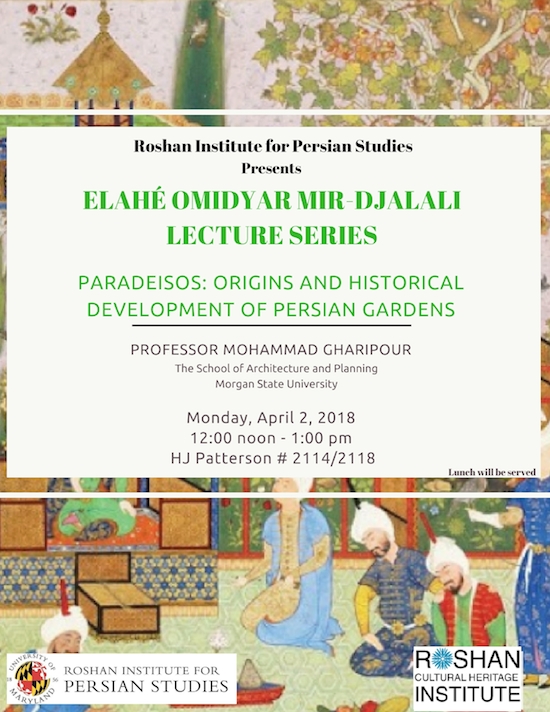
In celebration of Noruz, Roshan Institute for Persian Studies will be presenting “Paradeisos: Origins and Historical Development of Persian Gardens,” a talk by Professor Mohammad Gharipour, as part of The Elahé Omidyar Mir-Djalali Lecture Series at the University of Maryland, College Park. The Series is named in honor of Dr. Elahé Omidyar Mir-Djalali, the Founder, Chair and President of Roshan Cultural Heritage Institute.

Dr. Mohammad Gharipour is Professor at the School of Architecture and Planning at Morgan State University in Baltimore. Previously, he taught at Southern Polytechnic State University, Georgia Institute of Technology, University of North Carolina at Charlotte, and Maryland Institute College of Art. He is the recipient of the Hamad Bin Khalifa Fellowship in Islamic Art (2007), the Sprio Kostof Fellowship Award from the Society of Architectural Historians (2008), the Roshan Cultural Heritage Institute Fellowship for the publication of his book, Persian Gardens and Pavilions: Reflections in History, Poetry and the Arts (2010), the Morgan State University Award for Outstanding Research (2013), and the National Endowment in Humanities Faculty Award (2014). In February 2016, he was selected by Diverse: Issues in Higher Education magazine as one of twelve minority scholars who are making their mark in academia. Dr. Gharipour has published extensively on architectural and landscape history. He is also the Director and Founding Editor of the International Journal of Islamic Architecture. He received his Ph.D. in Architecture from Georgia Institute of Technology (2009) and his Masters in Architecture from the University of Tehran (2001).

Monday, April 2, 2018 | 12:00 p.m. – 1:00 p.m. | HJ Patterson 2114/2118 | University of Maryland, College Park

Find out more about RIPS at UMD

The Rose Empire: Masterpieces of 19th-century Persian Art Exhibition at the Louvre-Lens Museum

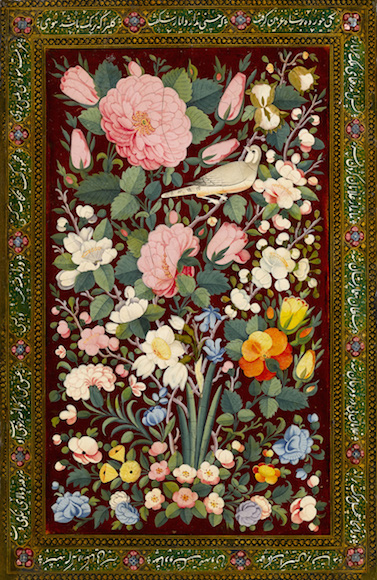
Roshan Cultural Heritage Institute is proud to announce the first major exhibition dedicated to the magnificent art of the Qajar dynasty, The Rose Empire: Masterpieces of 19th-century Persian Art, that will run at the Louvre Museum’s branch in Lens, northern France, from March 28 to July 23, 2018.

The Rose Empire: Masterpieces of 19th-Century Persian Art is a comprehensive and unprecedented overview of Qajar art, bringing together more than 400 works – paintings, drawings, jewelry, enamels, rugs, clothing, photographs and ceremonial weapons – all showcased by French fashion designer Christian Lacroix’s immersive and vibrant design.
The exhibition’s title is a reference both to Persian literature and to the seat of the Qajar dynasty, which ruled Iran from 1786 to 1925. It is named after the Golestan, the collection of poems by the 13th-century poet Saadi that was first translated into French in the 18th century by the orientalist Andre du Ryer under the title “The Rose Empire.” When the first Qajar sovereigns settled in Tehran, they gave their palace the same name, and to this day the kar-e Golestan (Golestan Palace) is still considered a masterpiece of Qajar art and architecture.

The exhibition is conceived as a stroll through the room of an opulent Qajar palace. Visitors enter the gallery through a monumental doorway inspired by a triple arcade that appears in a 19th-century Jules Laurens painting. The rooms are grouped into four architectural units, corresponding to the four main sections of the exhibition, and each unit is identified by different shades of a certain color that is characteristic of Qajar art: blue, red, green and yellow. The walls are hung with silk, and walkways are covered with rugs, recalling the sumptuousness of Iranian textiles.

Alongside the exhibition, curated by Gwenaëlle Fellinger, the museum is organizing a series of events and conferences, including an international colloquium reviewing current research on the art of the Qajar dynasty that will take place on June 21-23. All events will be hosted at La Scène, the main auditorium of the Louvre-Lens museum, situated in Lens, 200 kilometers north of Paris. The exhibition and accompanying colloquium are supported by the Elahé Omidyar Mir-Djalali Fund, established by Roshan Cultural Heritage Institute, as part of the Louvre Endowment Fund.

Learn more about the Rose Empire exhibition

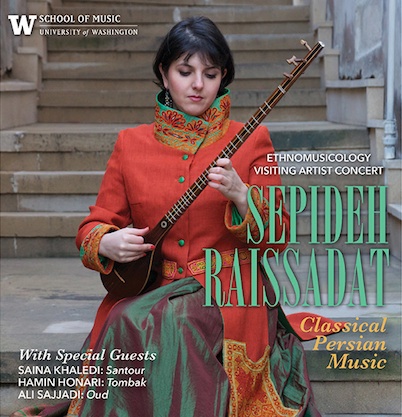
Sepideh Raissadat, Ethnomusicology Visiting Artist at the University of Washington School of Music

Roshan Cultural Heritage Institute is pleased to share that The School of Music of the University of Washington has invited Sepideh Raissadat (Roshan Institute Fellow, 2016) as a 2018 Winter Quarter Ethnomusicology Visiting Artist. While in Seattle during this Artist in Residence program, she is teaching Persian music to students with both its theoretical and practical aspects. At the end of her residency, Ms. Raissadat is expected to perform a concert accompanied by her students and by guest artists Sina Khaledi (Santour), Hamin Honari (Tombak) and Ali Sajjadi (Oud). The concert will be free and open to the public.

Ms. Raissadat is a Persian classical vocalist and musician, who began her recording career at the age of 18 with an album with Master Parviz Meshkatian (Konj-e Saburi, 1999). She was the first female vocalist to have a solo public performance in Iran after the 1979 revolution (Niavaran concert hall, 1999). As a child, she began studying Persian classical music with the famous Iranian Diva Parissa and later with renowned masters Parviz Meshkatian and Mohammad-Reza Lotfi. She has had numerous performances in Europe and North America and has garnered many invitations by prestigious institutions, including UNESCO, the Vatican and international media such as BBC and RAI.

In 2016, Ms. Raissadat was awarded a Roshan Institute Fellowship for Excellence in Persian Studies in support of her Rameshgari Project, which aims to rehabilitate the nearly forgotten traditional collaborative form of tasnif-composing. Ms. Raissadat obtained a B.A. degree in painting in Iran and holds a B.Mus degree from the University of Bologna and an MA in Ethnomusicology from the University of Toronto. She is currently continuing her doctoral studies in Ethnomusicology at the University of Toronto.

The UW Ethnomusicology’s visiting artist program has been a hallmark of the department for more than 50 years, bringing highly accomplished musicians to the university to work with students in applied music courses and public performances. Students study with artists from Afghanistan, China, India, Ireland, Korea, Puerto Rico, Senegal, Tanzania, and elsewhere.

Read more about Sepideh Raissadat

Find out more about the Rameshgari Project

Learn more about UW School of Music

New Elahé Omidyar Mir-Djalali Fund for Iranian Music at UCLA Herb Alpert School of Music

Roshan Cultural Heritage Institute is delighted to announce the establishment of the Elahé Omidyar Mir-Djalali Fund for Iranian Music in support of the Iranian Music Program over a two-year period at the Department of Ethnomusicology in the UCLA Herb Alpert School of Music. UCLA Department of Ethnomusicology is the only one of its kind in the U.S. and the most celebrated program in the world for the study of diverse musical cultures.

The Elahé Omidyar Mir-Djalali Fund for Iranian Music will enable UCLA to revive a program for the study of classical Iranian music, called Music of Persia, and the Persian Music Ensemble that were both initiated by Professor Hormoz Farhat in 1967, but regrettably removed from the curriculum in 1993, due to lack of funding. Thanks to our Fund, Department of Ethnomusicology Lecturer in Music, Dr. Amir Hosein Pourjavady, and Assistant Professor Munir Berken are now offering a total of eight classes on the music of Iran and the Persian-speaking world, covering both practical and theoretical aspects of major musical cultures of Iran, and in particular classical music. Persian Music Ensemble and Persian Music Ensemble-Percussion classes are offered on a quarterly basis, culminating in a year-end concert, for academic years 2017-2018 and 2018-2019.

Dr. Pourjavady received his Ph.D. in Near Eastern Languages and Cultures from UCLA, and his M.Phil. in Ethnomusicology from CUNY, Graduate Center. While at UCLA, he became the first recipient of the Roshan Institute Fellowship for Excellence in Persian Studies (2003-2004). He is a former professor at the University of Tehran, and a performer and scholar of Persian music, with expertise on the setar and vocal music. He teaches the Persian Music Ensemble and all seminar classes associated with the Iranian Music Program. Assistant Professor Beken’s career spans theory, composition, ethnomusicology (including the musics of Iran and Turkey) and performance. As a composer, he has written a state-commissioned ballet suite for orchestra, won awards for film music, and scored television documentaries. His scholarly work focuses on modal theory; he is also conducting research on music globalization and the phenomenology of music. He was one of the founding members of the State Turkish Music Ensemble.

Find more about the Persian Music Ensemble

Learn more about UCLA Herb Alpert School of Music

Intertwined Histories and Perspectives: Contrapuntal Reading of ʿAṭṭār, A Book Talk by Dr. Claudia Yaghoobi at UNC Chapel Hill

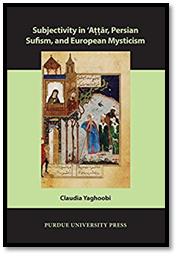
The University of North Carolina at Chapel Hill will present a talk by Dr. Claudia Yaghoobi on her new book, Subjectivity in ʿAṭṭār, Persian Sufism, and European Mysticism (Purdue University Press, 2017), on January 29, 2018, at the UNC FedEx Global Education Center.

By looking at ʿAṭṭār’s poetry contrapuntally with medieval European literature and modern theory, this talk will map out the ways ʿAṭṭār’s poetry interacts with itself within the Persian cultural and historical framework as well as with medieval European culture and modern Western theoretical perspectives in regard to the concepts of transgression and the breaking of taboos, and the construction of subjectivity. Traversing linguistic, national, and disciplinary boundaries, this talks calls into question the presumed differences between Medieval Islam and the West and makes possible a rich dialogue between civilizations that have historically been pitted against one another.

Dr. Claudia Yaghoobi is Roshan Institute Assistant Professor in Persian Studies and Persian Coordinator in the Department of Asian Studies at the University of North Carolina at Chapel Hill. She holds a Ph.D. in comparative literature from the University of California, Santa Barbara. Her research subjects include Persian literature, Iranian “woman question,” minorities in Iran, contemporary Middle Eastern literature, diasporic literature, literary theory, and gender and sexuality studies.

The book talk is free and open to the public.

Monday, January 29, 2018 | 6:00 p.m. – 7:30 p.m. | Room 1009, FedEx Global Education Center | UNC Chapel Hill

Learn more about UNC Persian Program

Two New Spring 2018 Courses offered by the School of Middle Eastern and North African Studies at the University of Arizona

The School of Middle Eastern and North African Studies (MENAS) recently announced the addition of two new courses for the Spring 2018 semester.

Islamic Spirituality through the Poetry of Rumi (MENA/PRS 353) will be taught by Dr. Austin O’Malley, the initial Roshan Institute Assistant Professor in Persian and Iranian Studies at the UA’s Roshan Graduate Interdisciplinary Program in Persian and Iranian Studies. This course takes the life, teachings, and poetry of Rumi, a central figure in the Persian Sufi tradition, as a starting point for a broader investigation into medieval Islamic spirituality, society, and literature. We also consider Rumi’s legacy in the modern period, including the many translations of his works and his reception by practitioners of New Age spirituality. Assessments include a final culminating project and short weekly presentations. It is open to both undergraduate and graduate students.

Genealogies of ISIS (MENA/POL 344) will be taught by Dr. Leila Hudson, Associate Professor in Modern Middle East Culture and Political Economy, at MENAS. Her course will examine the emergence and growth of the so-called Islamic State in Iraq and Syria. In addition to examining its origins, key figures, and milestones, the course will situate the organization in history, culture, and radicalization processes using a critical genealogical approach, paying special attention to the centrality of gender and sexuality, social media, and both local and global recruitment and net-works. Students will write a critical book review, an annotated bibliography of the emergent literature on a specific subject and design a research project using primary source material.

Students can have a minor in Persian by taking 18 units of these or other courses offered in upcoming semesters at the University of Arizona. The Roshan Graduate Interdisciplinary Program in Persian and Iranian Studies also offers M.A. and Ph.D. programs in Persian and Iranian Studies.

Learn more about Roshan GIDP

New Elahé Omidyar Mir-Djalali Postdoctoral Fellowship in Iranian Linguistics at UCLA

Roshan Cultural Heritage Institute is excited to announce its second endowment to the University of California, Los Angeles (UCLA) for the establishment of a new Elahé Omidyar Mir-Djalali Postdoctoral Fellowship in Iranian Linguistics at the Department of Linguistics in the Division of Humanities.

The UCLA Linguistics Department’s doctoral program has consistently been ranked as one of the top two or three such programs in the U.S. The Department began as an interdepartmental graduate master’s program in 1960. A doctoral program was introduced in 1962, a bachelor’s program was added in 1965, and the department was formally established in 1966.

The postdoctoral fellowship will be awarded for a two-year term with the possibility of a one-year extension. The Elahé Omidyar Mir-Djalali Postdoctoral Fellow will be expected to teach courses and conduct research on the linguistic heritage of Iran, focused on Persian and Iranian languages.

Roshan Cultural Heritage Institute is proud to partner again with UCLA Division of Humanities, where the Elahé Omidyar Mir-Djalali Fellowship for Excellence in Persian Studies has been established since 2002.

Read the press release

Learn more about UCLA Department of Linguistics

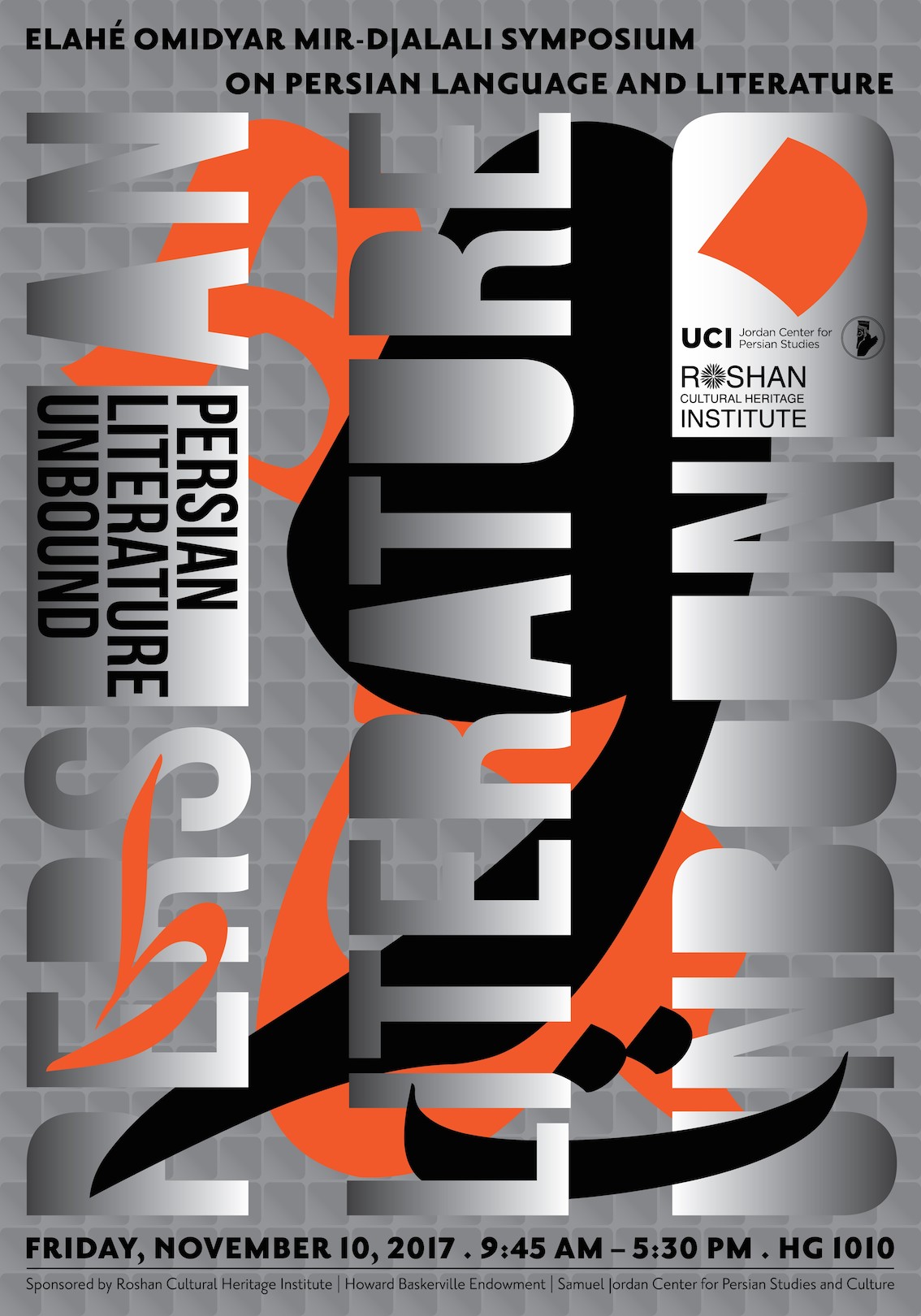
Elahé Omidyar Mir-Djalali Symposium on Persian Language and Literature: Persian Literature Unbound at UC Irvine, November 10, 2017

Roshan Cultural Heritage Institute is pleased to sponsor the all-day conference, titled The Elahé Omidyar Mir-Djalali Symposium on Persian Language and Literature: Persian Literature Unbound on Friday, November 10, 2017, 9:45 am – 6 pm, in UC Irvine’s Humanities Gateway (HG) 1010.

This event is organized by Dr. Nasrin Rahimieh, Howard Baskerville Professor of Comparative Literature at UC Irvine’s School of Humanities. The participants in this conference are invited to reflect on possibilities of redrawing the temporal, geographic, generic, and methodological boundaries that have delimited what we consider to be the proper domain of Persian literature and how we produce knowledge about it. At the event, participants will address questions, such as: What types of writing can be considered literature? How might we rethink periodization? Can Persian literature be read across linguistic and national boundaries? How might we study and teach Middle Persian and Persian literature within the broader framework of world literature? The participants will also be invited to contribute to a volume of essays to be published after the symposium.

This event is free and open to the public. No registration is required.

Find out more about the Symposium