Noruz Mobarak from Roshan Cultural Heritage Institute!
This most cherished Persian celebration goes back at least 3000 years and is about “Celebrating Life renewal in health and harmony with nature”

Noruz – literally “New Day” – is the Persian New Year and symbolizes renewal and rebirth. The celebration of Noruz dates back several thousand years, to the time of the Achaemenids. Noruz starts at the exact instant of the Vernal Equinox, which occurs each year around the 21st of March, the first day of spring. This most important Iranian holiday is a time for family and friends to gather together and is marked with a myriad of activities affecting everything from preparations and celebrations to food, clothing, gift giving, charity, and many other social and family activities.

Haftsin (Haft Seen) is the spread, around which the Family gathers to celebrate Noruz. Iranians take pride in putting together an attractive and elaborate spread to represent both spiritual and worldly symbols promising a happy start of the New Year. The Persian word Haft means seven and Sin refers to the sound /S/ in the language. Usually a nice embroidered fabric is used as the foundation of the spread. On the spread seven specific items starting with the sound /S/ are displayed. The set is prepared a day or two before Noruz and given a place of honor in the house to remain 13 days following Noruz. Additional items are also placed on the Haftsin that will signify renewal, life, happiness, spiritual purity, prosperity, fertility, growth, good health and all things one desires for the New Year. This celebration is one of hope, promise and good fortune to enjoy and share with friends and family.

List of items for Haftsin

# Name Definition Symbolism
1 Sabzeh Spring Sprouts Growth, prosperity and togetherness
2 Senjed Dry fruit of lotus, “mountain-ash” Tart and sweet tastes in life
3 Seeb Apple The oldest beneficial fruit
4 Samanu Wheat Pudding A sweet prepared with the extract of young growth of wheat
5 Serkeh Vinegar An astringent agent, medicinal
6 Somagh Crushed Sumac Berries The oldest beneficial condiment derived from a plant
7 Seer Garlic The oldest bulb with medicinal Value
8 Sekkeh Coins, (Silver and Gold) Permanence and prosperity
9 Sombol Hyacinth Flower Life development: flower from the bulb to the roots
10 Mahi Gold fish Life energy
11 Ayne A Mirror Purity and clarity
12 Sham’ Two Candelabras Spiritual light and warmth
13 Tokhm-e Morgh Decorated Eggs Life in potential
14 Scriptures Koran, Bible, Torah, etc. Blessings and faith
15 Sepand, Esfand Wild Rue Incense against the evil eye that helps the lungs function

New M.A. and Ph.D. Programs in Persian and Iranian Studies at the University of Arizona

Roshan Cultural Heritage Institute is delighted to announce that the newly established Roshan Graduate Interdisciplinary Program in Persian and Iranian Studies at the University of Arizona’s Graduate School will be admitting a very limited number of graduate students at the M.A. and Ph.D. level for the 2017-2018 academic year.

The Persian and Iranian Studies degrees will focus specifically on either modern or classical Persian literature and culture, or Iranian (or other Persian speaking societies’) history, religion, social organization, and politics. For both, superior language competency in Persian is expected.

In 2016, the University of Arizona received a multimillion-dollar grant from Roshan Cultural Heritage Institute to establish the Roshan Graduate Interdisciplinary Program in Persian and Iranian Studies. Professor Kamran Talattof, a professor in Persian language and literature, serves as the initial Roshan Institute Chair in Persian and Iranian Studies and Director of the Roshan Graduate Interdisciplinary Program.

To apply and for more information about the program and availability of financial support, visit www.persian.arizona.edu.

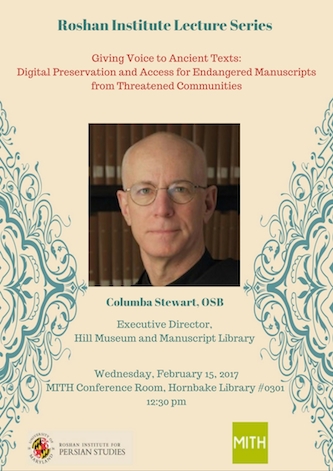
UMD Roshan Institute Lecture Series: Giving Voices to Ancient Texts

Roshan Cultural Heritage Institute is pleased to announce “Giving Voice to Ancient Texts: Digital Preservation and Access for Endangered Manuscripts from Threatened Communities,” a presentation by Columba Stewart, OSB, Executive Director, Hill Museum and Manuscript Library (HMML), on February 15, 2017, at the University of Maryland. The presentation is part of the Roshan Institute Lecture Series at UMD Roshan Institute for Persian Studies.

In this presentation, Columba Stewart, a graduate of Harvard, Yale and Oxford universities, will explain how a Benedictine monastery in Minnesota became involved in such a massive effort to document cultural heritage; describe the challenges of data management and workflow; and present HMML’s online environment for manuscript studies, virtual Hill Museum & Manuscript Library (vHMML), which includes a Reading Room that will ultimately offer almost 100,000 complete digitized manuscripts to scholars around the world. HMML is now partnering with the Roshan Institute for Persian Studies at UMD on projects to digitize, describe, and share Persian manuscripts endangered by conflict and environmental challenges.

The lecture is free and open to the public.

Wednesday, February 15, 2017 | 12:30 p.m. – 1:30 p.m. | Conference Room, Hornbake Library #0301 | University of Maryland College Park

Find out more about the event

Find out more on vHMML

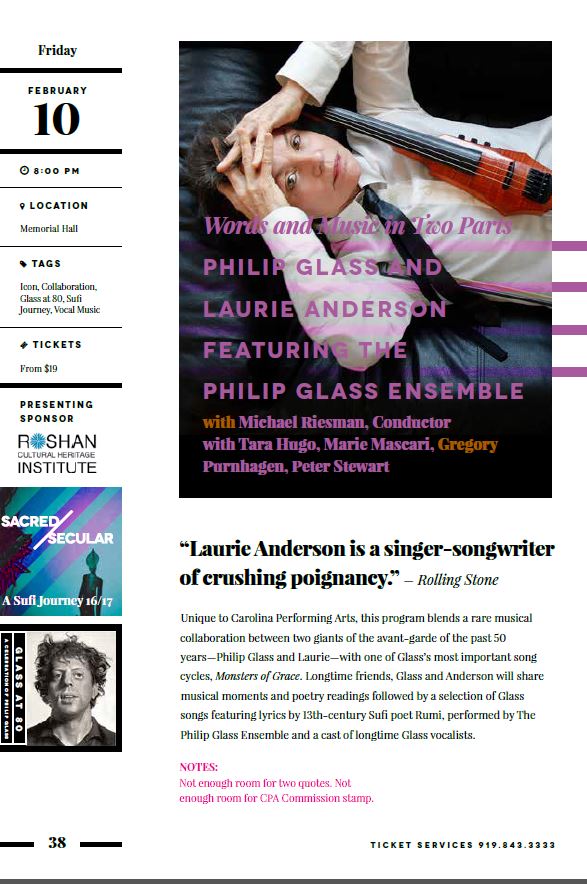
Philip Glass and Laurie Anderson “Words and Music in Two Parts” at Carolina Performing Arts

Roshan Cultural Heritage Institute is delighted to sponsor the performance of Words and Music in Two Parts, on February 10, 2017, at Memorial Hall, Carolina Performing Arts’ main venue located in the center of the University of North Carolina-Chapel Hill campus.

Unique to Carolina Performing Arts, this program blends a rare musical collaboration between two giants of the avant-garde of the past 50 years—Philip Glass and Laurie Anderson—with one of Glass’s most important song cycles, Monsters of Grace. Longtime friends, Glass and Anderson will share musical moments and poetry readings followed by a selection of Glass songs featuring lyrics by 13th-century Sufi poet Rumi, performed by The Philip Glass Ensemble and a cast of longtime Glass vocalists including Tara Hugo, Marie Mascari, Gregory Purnhagen and Peter Stewart.

Words and Music in Two Parts is one of six performances held at Carolina Performing Arts, February 1-10, 2017, in celebration of Glass’s 80th birthday. Glass at 80 features the extraordinary impact Philip Glass has had upon the musical and intellectual life of his time. Glass’s associations, personal and professional, with leading rock, pop and world music artists date back to the 1960s.

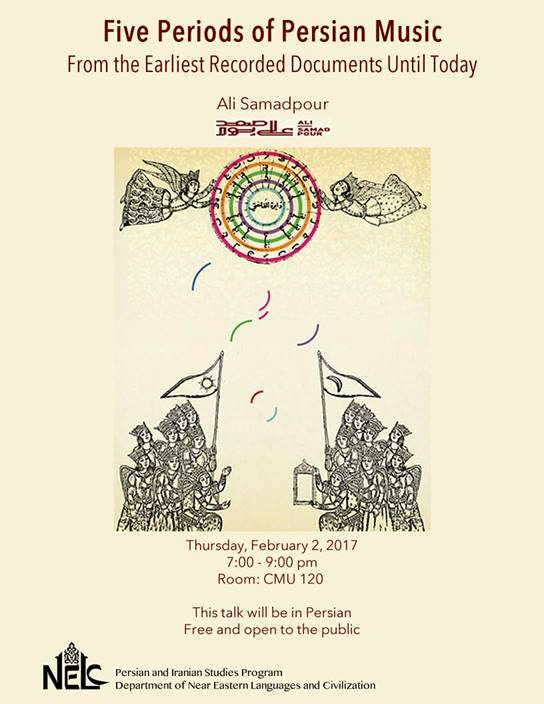
UW – NELC “Five Periods of Persian Music: From the Earliest Recorded Documents until Today”

The Department of Near Eastern Languages and Civilization (NELC) at the University of Washington (UW) invites faculty, students and the Seattle community for a Persian and Iranian Studies Program (PISP) sponsored event with great Iranian composer and multi-instrumentalist (Tar, Setar, Rabab, Uod) Ali Samadpour.

In addition to his solo and ensemble releases, Ali Samadpour has contributed to multiple soundtracks including: Tardid, Dar miane abrha, The Other Side of Burka, Alzheimer, Nose, Iranian Style, and Mandoo.

This talk will be in Persian. The event is free and open to the public.

Thursday, February 2, 2017 | 7:00 p.m. – 9:00 p.m. | Communications Building (CMU), Room 120 | University of Washington.

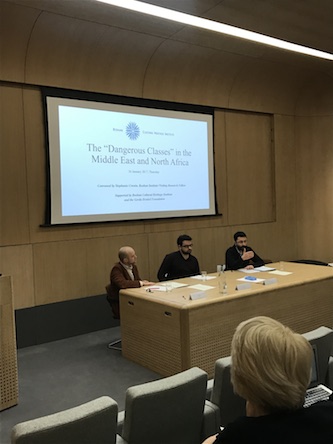
Successful Conference organized by Dr. Stephanie Cronin at St Antony’s College, University of Oxford

Roshan Cultural Heritage Institute is proud to share that the “Dangerous Classes” in the Middle East and North Africa conference, organized by Roshan Institute Visiting Research Fellow, Dr. Stephanie Cronin, was successfully held on January 26, 2017, at St Antony’s College, University of Oxford, with more than 100 in attendance.

The concept of the “dangerous classes” was born in mid-nineteenth century Europe and became famous after the publication in 1872 in New York of a book with the same title by the American social reformer Charles Loring Brace. The conference took as its central theme this notion of the “dangerous classes”. Sessions were led by ten scholars who examined its explanatory power when applied to the Middle East and North Africa in the period from around 1800 to the present.

Dr. Cronin is currently the Roshan Institute Visiting Research Fellow at St. Antony’s College (2015-2018) and a Lecturer in the Faculty of Oriental Studies, University of Oxford. She has also held an Iran Heritage Foundation fellowship for many years. She is the author of many books on modern Iranian history and is currently working on a social history of modern Iran “from below”. Dr. Cronin received her Ph.D. in History (1992) and her M.A. in Middle East Studies (1981) from the School of Oriental and African Studies.

Find out more about the Conference

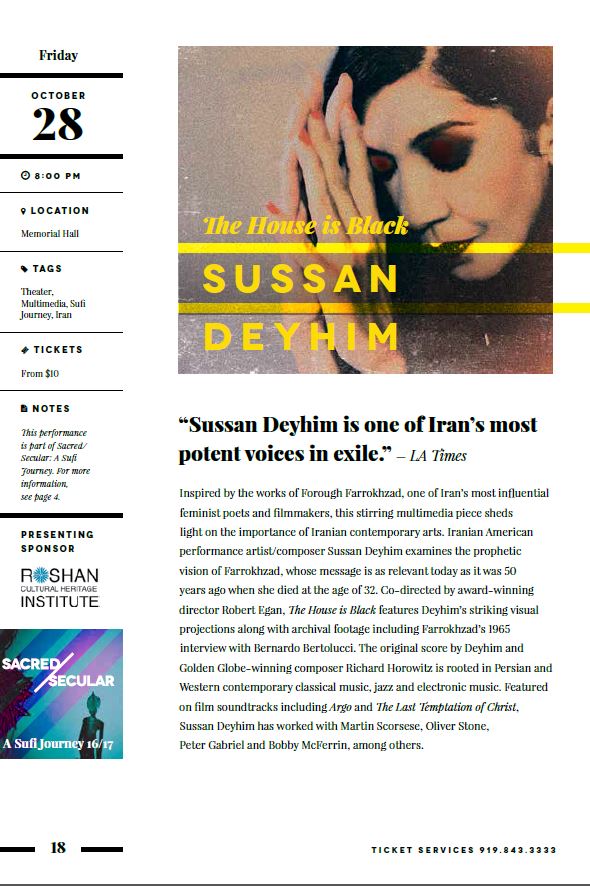
Sussan Deyhim’s “The House is Black” at Carolina Performing Arts

Roshan Cultural Heritage Institute is pleased to sponsor the performance of avant-garde Iranian composer and vocalist Sussan Deyhim’s acclaimed production The House is Black, on October 28, 2016, at Memorial Hall, Carolina Performing Arts’ main venue located in the center of the University of North Carolina-Chapel Hill campus.

Inspired by the works of Forough Farrokhzad, one of Iran’s most influential feminist poets and filmmakers, this stirring multimedia piece sheds light on the importance of Iranian contemporary arts. Co-directed by award-winning director Robert Egan, The House is Black features Sussan Deyhim’s striking visual projections along with archival footage including Farrokhzad’s 1965 interview with Bernardo Bertolucci. The original score by Sussan Deyhim and Golden Globe-winning composer Richard Horowitz is rooted in Persian and Western contemporary classical music, jazz and electronic music.

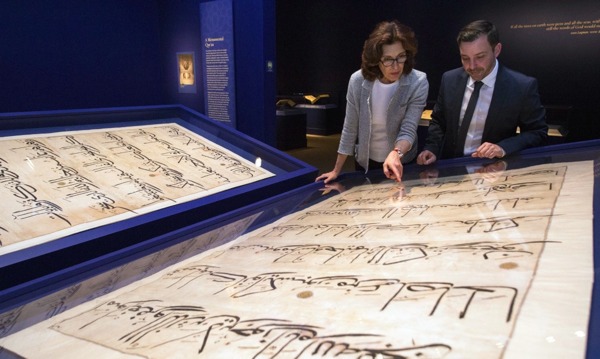
The Art of the Qur’an: Treasures from the Museum of Turkish and Islamic Arts

Opening Saturday, October 22, 2016, at the Smithsonian Institution is The Art of the Qur’an: Treasures from the Museum of Turkish and Islamic Arts, an international loan exhibition featuring some fifty of the most sumptuous Qur’ans from Herat to Istanbul. Celebrated for their superb calligraphy and lavish illumination, these manuscripts—which range in date from the early eighth to the seventeenth century—are critical to the history of the arts of the book. They were once the prized possessions of Ottoman sultans and the ruling elite, who donated their Qur’ans to various institutions to express their personal piety and secure political power. Each manuscript tells a unique story, which will be explored in this once-in-a-lifetime exhibition. Curated by Dr. Massumeh Farhad, the exhibition runs at the Arthur M. Sackler Gallery from October 22, 2016 through February 20, 2017, with an opening gala reception on October 19.

Be among the first to see these exceptional manuscripts during a day of free events for all ages, on Saturday, October 22, 11am to 5pm, on Sackler Gallery Sublevel 1. Activities include curator-led tours of the exhibition, calligraphy demonstrations, and musical storytelling performances.

Accompanying this spectacular exhibition is a lavishly illustrated catalogue that includes essays from various scholars and discussion of each object on display. Roshan Cultural Heritage Institute is proud to support this scholarly catalogue and provide its Foreword.

Read more about the Exhibition

Sussan Moinfar Appointed New Roshan Institute Lecturer in Persian Studies at the University of Maryland, College Park

Roshan Cultural Heritage Institute is delighted to announce the appointment of Sussan Moinfar as the inaugural Roshan Institute Lecturer in Persian Studies at Roshan Institute for Persian Studies, University of Maryland, College Park.

Ms. Moinfar has been a Lecturer and Associate Director for Cultural Programing and Development at Roshan Institute for Persian Studies since 2013. Prior to joining the University of Maryland, she was a Lecturer in Persian and directed the Persian program at George Mason University’s Department of Modern and Classical Languages (Spring 2011-2013). And, prior to that position, she was a Lecturer in Persian and Program Director at the Princeton University’s Department of Near Eastern Studies (Spring 2004-2010). Ms. Moinfar moved from Iran to the US as a teenager, attended high school in Texas, and graduated with a Bachelor’s degree in Architectural Engineering from The University of Texas at Austin.

Ms. Moinfar will teach core courses in Persian reading, composition and cultural literacy.

Roshan Cultural Heritage Institute congratulates Ms. Moinfar and wishes her years of success as the inaugural Roshan Institute Lecturer in Persian Studies.

Read more about Roshan Institute for Persian Studies

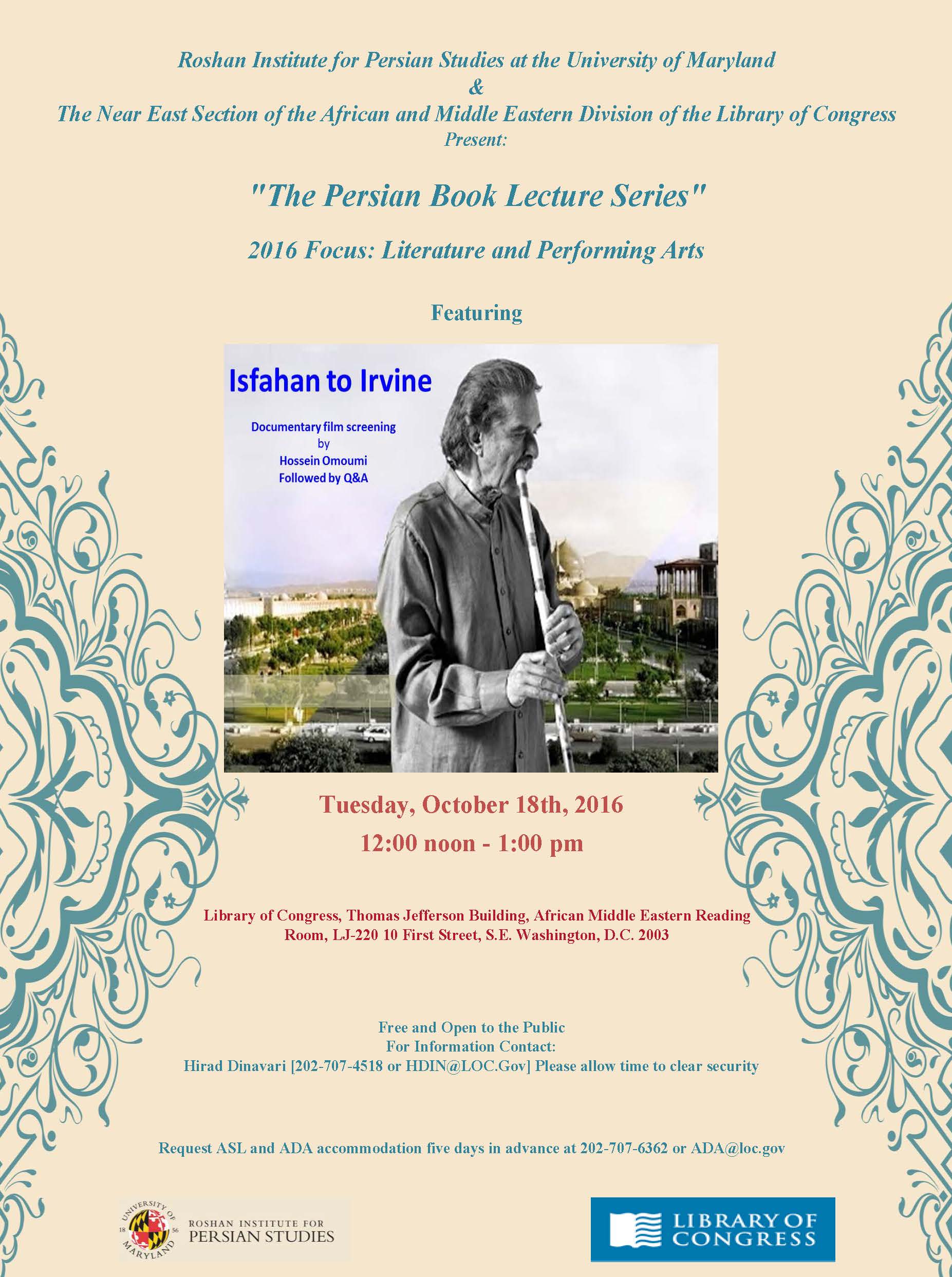
Documentary Film Screening by Hossein Omoumi at the Library of Congress

As part of “The Persian Book Lecture Series”, the Library of Congress and Roshan Institute for Persian Studies at University of Maryland, College Park, present the documentary film, “Classical Persian Music – Hossein Omoumi from Isfahan to Irvine”. Partly funded by a grant from Roshan Cultural Heritage Institute, the documentary introduces the history and beauty of classical Persian music through Professor Hossein Omoumi’s innovations in education and musical technology.

Dr. Omoumi, Maseeh Professor of Persian Performing Arts at the University of California, Irvine, is an internationally recognized musician, master of the Persian reed flute (ney), teacher and scholar. He has made it his life’s mission to provide global access to classical Persian music.

The screening will be followed by a Q&A with the Maestro himself. The event is free and open to the public.

Tuesday, October 18, 2016 | 12:00 p.m. – 1:00 p.m. | Thomas Jefferson Building, African Middle Eastern Reading Room, LJ-220 | Library of Congress