Professor Matthew Canepa appointed new Elahé Omidyar Mir-Djalali Presidential Chair in Art History and Archaeology of Ancient Iran at the University of California, Irvine

The University of California, Irvine (UCI) is delighted to welcome Professor Matthew Canepa as the new Elahé Omidyar Mir-Djalali Presidential Chair in Art History and Archaeology of Ancient Iran, established thanks to an endowment from Roshan Cultural Heritage Institute in 2017. Professor Canepa’s appointment is within the UCI School of Humanities’ Department of Art History and Ph.D. Program in Visual Studies, and affiliated with the UCI Samuel Jordan Center for Persian Studies.

Professor Canepa is an award-winning historian of art, archaeology and religions of Persia and wider Iranian world. He comes to UCI from the University of Minnesota where he was a Professor and Director of Graduate Studies in the Department of Art History and affiliated faculty in Classical Near Eastern Studies. He has held visiting positions at Merton College, Oxford, where he was Senior Research Fellow, and L’Ecole Pratique des Hautes Etudes in Paris, where he served as Directeur d’études invité. He earned his Ph.D. in Art History from the University of Chicago and his B.A. in Art History and Psychology from the University of Colorado, Boulder.

Professor Canepa is the author of two books, an edited volume, and several book chapters and articles. His most recent book, The Iranian Expanse (University of California Press, 2018), is a large-scale study of the transformation of Iranian cosmologies, landscapes and architecture from the height of the Achaemenids to the coming of Islam. His first book, entitled The Two Eyes of the Earth (University of California Press, 2009; paperback edition, 2017), is an award-winning and pioneering comprehensive study of the artistic, ritual and ideological interactions between the late Roman and Sasanian empires. It was awarded the 2010 James Henry Breasted Prize from the American Historical Association for best book in English on any field of history prior to the year 1000 CE and the Archaeological Institute of America’s von Bothmer Publication Fund.

Roshan Cultural Heritage Institute and its Founder and Chair, Dr. Elahé Omidyar Mir-Djalali, extend a warm welcome to Professor Matthew Canepa as our new Chair at UCI.
Read more about the Appointment of Professor Canepa

Learn more about Professor Matthew Canepa

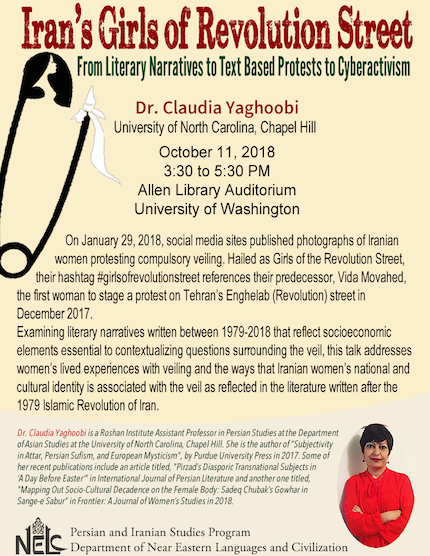
Iran’s Girls of Revolution Street, a Lecture by UNC Roshan Institute Assistant Professor Claudia Yaghoobi at the University of Washington

Roshan Cultural Heritage Institute is pleased to share that the Persian and Iranian Program at the University of Washington has invited Dr. Claudia Yaghoobi to give a lecture titled Iran’s Girls of Revolution Street: From Literary Narratives to Text-Based Protests to Cyberactivism, on October 11, 2018, at the UW Allen Library Auditorium.

Dr. Claudia Yaghoobi is Roshan Institute Assistant Professor in Persian Studies and Coordinator of the Persian Program in the Department of Asian Studies at the University of North Carolina, Chapel Hill. She is the author of Subjectivity in ‘Attar, Persian Sufism, and European Mysticism (Purdue University Press, 2017) and her recent publications include an article titled, “Pirzad’s Diasporic Transnational Subjects in ‘A Day Before Easter’” in International Journal of Persian Literature and another one titled, “Mapping Out Socio-Cultural Decadence on the Female Body: Sadeq Chubak’s Gowhar in Sange-e Sabur” in Frontier: A Journal of Women’s Studies in 2018.

Examining literary narratives written between 1979-2018 that reflect socioeconomic elements essential to contextualizing questions surrounding the veil, Dr. Yaghoobi’s lecture addresses women’s lived experiences with veiling and the ways that Iranian women’s national and cultural identity is associated with the veil as reflected in the literature written after the 1979 Islamic Revolution of Iran. In order to produce a nuanced analysis of these themes, Dr. Yaghoobi’s approach selects literary narratives as “literary counterpublics” in Hoda Elsadda’s words (2010), or discursive mechanisms of counter-discourses shaped alongside official narratives pertinent to a social and cultural issue, here the modest dress codes and mandatory public hijab.

This lecture is free and open to the public. Seating is limited.

Thursday, October 11, 2018 | 3:30 p.m. – 5:30 p.m. | Allen Library Auditorium | University of Washington

Learn more about UW Persian and Iranian Studies Program

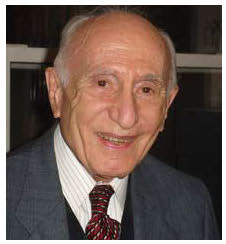
The Sad News of Professor Ehsan Yarshater’s Passing at Age 98

Roshan Cultural Heritage Institute notes with deep regrets the passing of Professor Ehsan Yarshater on September 1, 2018, in Fresno, California. He was 98.
Professor Yarshater was a brilliant educator, prolific author and generous philanthropist, who advanced the scholarship and understanding of Iranian Studies worldwide. He was associated with Columbia University since 1958 when he was first invited as Visiting Associate Professor of Indo-Iranian for two years. At Columbia, he held a long and distinguished career and was most recently Hagop Kevorkian Professor Emeritus of Iranian Studies and Director of the Center for Iranian Studies (now the Ehsan Yarshater Center for Iranian Studies) which he founded in 1968.

Among Professor Yarshater’s many publications are volumes on Persian poetry, Persian literature, and Persian dialects. He also edited volume 3 of the Cambridge History of Iran covering the Seleucid, Parthian and Sasanian periods. However, his greatest achievement and legacy is as Founding Editor of Encyclopaedia Iranica, an internationally renowned resource for the study of Iranian history and cultural heritage, which Roshan Cultural Heritage Institute is proud to have been a supporter of since 2002.

Professor Yarshater will be sorely missed by countless friends, admirers, and scholars he touched with his numerous academic, service and philanthropic efforts. Roshan Cultural Heritage Institute offers its deepest condolences to his family.

Read more about Encyclopædia Iranica

Roshan Institute Fellows and Recent Accomplishments

Roshan Cultural Heritage Institute is delighted to share news about some of its Fellows and their recent accomplishments.

Vahideh Rasekhi obtained her Ph.D. in Linguistics from Stony Brook University in August 2018. Her primary area of interest is syntax (ellipsis, long-distance dependencies, and passive/causative structures) and she wrote her dissertation on “Ellipsis and Information Structure: Evidence from Persian,” for which she was awarded a Roshan Institute Fellowship for Excellence in Persian Studies in academic year 2017-18. Dr. Rasekhi will continue her research on the syntax of Iranian languages at UCLA Department of Linguistics, where she has been selected as the inaugural Elahé Omidyar Mir-Djalali Postdoctoral Fellow in Iranian Linguistics. This postdoctoral fellowship carries a term of two years, with the possibility for a one-year extension.

Soodabeh Malekzadeh successfully completed her Ph.D. in History from the University of California, Irvine, in May 2018. Her research interests include ancient Persian languages, ancient Iranian religion and tradition as well as Persian mythology and literature. She was awarded our Elahé Omidyar Mir-Djalali Fellowship for Excellence in Persian Studies for the completion of her doctoral dissertation, entitled “The Sasanian Empire in the Fifth Century: The Case of Yazdegerd I and Bahram V,” in academic year 2017-18.

Dr. Matthew Miller has been appointed Assistant Professor of Persian and the Associate Director of the Roshan Initiative in Persian Digital Humanities at the University of Maryland, College Park. His research focuses on medieval Sufi literature, the history of sexuality and the body, and digital humanities. He holds a Ph.D. in Comparative Literature (Persian and Arabic) from Washington University in St. Louis, for which he had received a Roshan Institute Fellowship for Excellence in Persian Studies in academic year 2012-13.

Roshan Cultural Heritage Institute would like to commend all Fellows for their contributions to Persian Studies scholarship and wishes them continued success.

New Elahé Omidyar Mir-Djalali Fellows for 2018-19

Roshan Cultural Heritage Institute wishes to congratulate the following two Ph.D. candidates for being awarded our Elahé Omidyar Mir-Djalali Fellowship for Excellence in Persian Studies for the completion of their doctoral studies in academic year 2018-19.

Elham Monfaredi is a Ph.D. candidate in the Department of Second Language Studies at the University of Hawaii at Manoa (UHM). Her research interests include cross-cultural pragmatics, inter-language pragmatics, discourse analysis and conversational analysis. She has been a Graduate Assistant in the Persian Language, Linguistics and Culture Program at UHM for academic years 2014-2018, during which she was awarded the Roshan Institute Fellowship in Persian Linguistics, Language Acquisition and Applied Linguistics three years in a row. She has also been a Persian Instructor in the Persian Language Summer Institute at the University of Maryland in the summers of 2016, 2017 and 2018. Ms. Monfaredi expects to defend her dissertation, entitled “Storytelling in Persian Language Classrooms: A Conversation Analytic Perspective,” in spring 2019.

Dr. Gündoğdu joined Professor Kahnemuyipour in September 2019, for a two-year term, to work on the first phase of his five-year project, which aims to investigate the syntax of nominal linkers across languages. Starting with the better-studied Persian case known as the Ezafe, in its first stage, the project takes on a systematic comparative investigation of several Iranian languages to establish the properties nominal linkers in each of these languages possess. The project team is currently compiling data on several Iranian languages–Kurmanji, Zazaki, Gilaki, Sorani Kurdish and Ossetian–to provide a cross-classification of nominal linkers based on a detailed study of their properties in these languages.

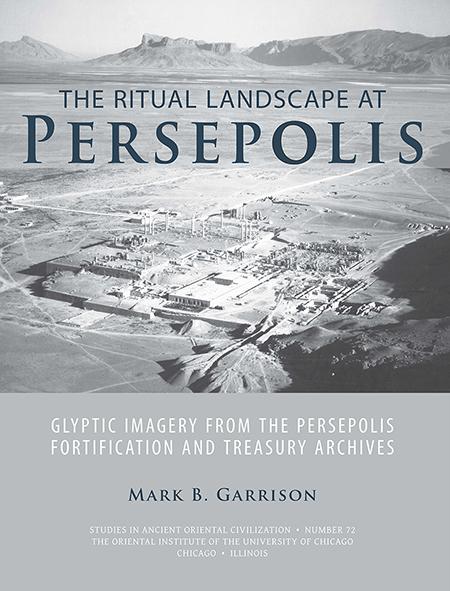
Congratulations to Professor Mark Garrison, Winner of the 2018 Ehsan Yarshater Book Award for his New Publication, The Ritual Landscape at Persepolis

Roshan Cultural Heritage Institute wishes to congratulate Professor Mark B. Garrison for being the winner of the 2018 Ehsan Yarshater Book Award for his new book, The Ritual Landscape at Persepolis: Glyptic Imagery from the Persepolis Fortification and Treasury Archives (The University of Chicago: SAOC 72, 2018). The award was given out at the opening ceremony of the Association for Iranian Studies Twelfth Biennial Conference that took place at the University of California, Irvine, on August 14-17, 2018.

Named in honor of Professor Ehsan Yarshater, an internationally recognized scholar who has made a major contribution to the field of Iranian Studies, the purpose of this book award is to advance the scholarship on Ancient Iranian Civilization and its cognate fields.


The Ritual Landscape at Persepolis focuses on a corpus of glyptic imagery preserved as impressions on two large archives of administrative tablets from Persepolis, the Persepolis Fortification archive (509–493 BC) and the Persepolis Treasury archive (492–457 BC). The glyptic imagery published in The Ritual Landscape at Persepolis concerns representations of what have been traditionally termed “fire altars” and/or “fire temples”; and are the most numerous, the most visually complex, and the best dated and contextualized evidence that currently exists for the study of religious ritual in early Achaemenid Iran. The publication was made possible thanks to a grant by Roshan Cultural Heritage Institute.

Mark B. Garrison is Alice Pratt Brown Professor of Art and Art History at Trinity University, where he has been teaching since 1989. He also is the Editor of the Persepolis Fortification Archive (PFA) project at the Oriental Institute, The University of Chicago. His primary research interests are the glyptic arts of ancient Iran and Iraq in the early first millennium B.C. He has devoted decades of study to the PFA tablets and is known as the foremost expert on Achaemenid glyptic art, having published extensively on the subject.

Download The Ritual Landscape at Persepolis

Learn more about the Association for Iranian Studies

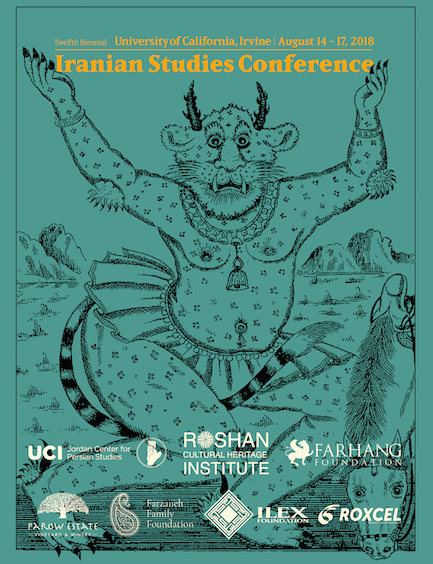
Twelfth Biennial Iranian Studies Conference at UC Irvine, August 14-17, 2018

The Twelfth Biennial Iranian Studies Conference of the Association for Iranian Studies (AIS) will be held on August 14-17 at the Dr. Samuel Jordan Center for Persian Studies at the University of California, Irvine (UCI). The AIS Biennial Conferences are the largest worldwide gatherings of scholars in the field of Iranian Studies. Organized under the leadership of the AIS President, Professor Touraj Daryaee, who is also the Director of UCI Jordan Center, the 2018 Iranian Studies Conference will not only include academic presentations from renowned faculty members, active scholars, and promising students in the field, but also provide opportunities for networking and establishing professional contacts. A number of additional events such as book launches, receptions, Persian classical music performances and Persian poetry readings will also take place.

Roshan Cultural Heritage Institute is delighted to continue its support of the Biennial Conference this year and congratulates the Association for Iranian Studies and all participating presenters for their outstanding efforts to promote Persian studies scholarship.

Find more about the Conference

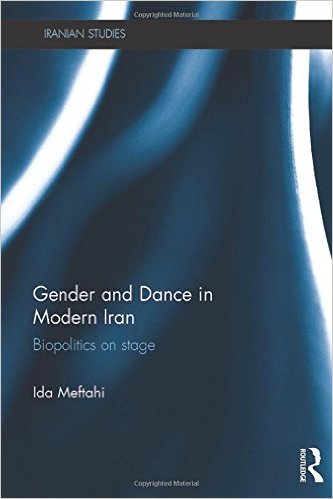
Congratulations to Dr. Ida Meftahi, Recipient of the 2018 Latifeh Yarshater Award for her first book, “Gender and Dance in Modern Iran: Biopolitics on Stage”

Roshan Cultural Heritage Institute is proud to announce that Dr. Ida Meftahi’s first book, Gender and Dance in Modern Iran: Biopolitics on Stage (Routledge, 2016) won the 2018 Latifeh Yarshater Award for the best book in the field of Iranian women’s studies. The award was given out at the Association for Iranian Studies Twelfth Biennial Conference that took place at the University of California, Irvine, on August 14-17, 2018.

Named in honor of Latifeh Yarshater and her lifelong dedication to the improvement of Iranian women’s human rights, this award is to encourage scholarship in Iranian studies focused on the condition of women in Persian-speaking societies and to promote women’s rights in these societies.

Gender and Dance in Modern Iran: Biopolitics on Stage investigates the way dancing bodies have been providing evidence for competing representations of modernity, urbanism, and religiosity across the twentieth century. The book, which research was supported by a fellowship from Roshan Cultural Heritage Institute, traces the dancing body in multiple milieus of performance, including the Pahlavi era’s national artistic scene and the popular café and cabaret stages, as well as the commercial cinematic screen and the post-revolutionary Islamized theatrical stage.

Dr. Meftahi has been a Visiting Assistant Professor in Contemporary Iranian Culture and Society at the Roshan Institute for Persian Studies at the University of Maryland, College Park, since 2014. In addition to teaching, she is the director of the “Lalehzar Digital Project” as well as the faculty advisor for Roshangar: Roshan Undergraduate Journal for Persian Studies. Dr. Meftahi holds a Ph.D. in Near and Middle Eastern Civilizations from the University of Toronto (2013) and an M.A. in Dance from York University, Canada (2007).

Roshan Institute for Persian Studies warmly congratulates Dr. Meftahi for this award and wishes her continued success in her academic work.

Read more about Dr. Ida Meftahi

Learn more about the Association for Iranian Studies

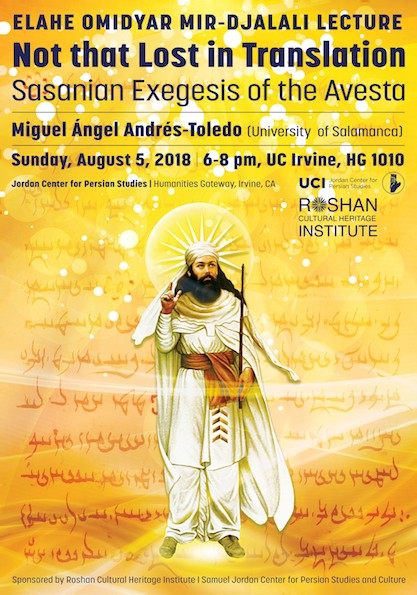
Elahé Omidyar Mir-Djalali Lecture: “Not that Lost in Translation: Sasanian Exegesis of the Avesta” by Dr. Miguel Ángel Andrés-Toledo at UC Irvine, August 5, 2018

Roshan Cultural Heritage Institute is pleased to announce the first Elahé Omidyar Mir-Djalali Lecture, that is scheduled to take place on Sunday, August 5, 2018, 6:00 pm – 8:00 pm, at UC Irvine’s Humanities Gateway (HG) 1010.

This event is organized by Professor Touraj Daryaee, Director of UCI Jordan Center for Persian Studies & Culture, and will feature a lecture titled “Not that Lost in Translation: Sasanian Exegesis of the Avesta” by Dr. Miguel Ángel Andrés-Toledo, Ramón y Cajal Research Fellow at the University of Salamanca, Spain.

Dr. Andrés-Toledo is an expert on Avestan and Pahlavi texts, and his research interests also include Old and Middle Iranian languages and literatures, Zoroastrianism, Iranian lexicography as well as Indo-Iranian and Indo-European Linguistics.

The lecture is free and open to the public. No registration is required.

Find out more about UCI Jordan Center

New Elahé Omidyar Mir-Djalali Professor of Persian Language at the University of Arizona

Roshan Cultural Heritage Institute is proud to announce a new endowment to the University of Arizona to establish the Elahé Omidyar Mir-Djalali Professor of Persian Language at the School of Middle Eastern and North African Studies in the College of Social and Behavioral Sciences.

The new professor will teach Persian language courses at all levels and will develop curriculum and teaching materials. The Elahé Omidyar Mir-Djalali Professor of Persian Language will also contribute to the activities and programs of the Roshan Graduate Interdisciplinary Program in Persian and Iranian Studies, which was established in the UA’s Graduate College in 2016 with an endowment from Roshan Cultural Heritage Institute. Recruitment for the position has begun, and it is anticipated that the new faculty member will begin this fall.

This is Roshan Cultural Heritage Institute’s third endowment to the University of Arizona. In 2003, an endowment for Roshan Institute Fellowship for Excellence in Persian Studies was established in the School of Middle Eastern and North African Studies for outstanding graduate students in Persian and Iranian studies. The Roshan Graduate Interdisciplinary Program in Persian and Iranian Studies established in 2016 includes funding for an endowed faculty chair and an endowed professorship – both already filled – as well as for programming activities and new master’s and doctoral degree programs. The three endowments combined bring Roshan Cultural Heritage Institute’s total gifts to nearly $3.5 million in support of the renowned Persian and Iranian Studies program at the University of Arizona.

Read more about the Endowment at UA

Read the announcement at SBS