Roshan Institute Fellows and Recent Accomplishments

Roshan Cultural Heritage Institute is delighted to share news about some of its Fellows and their recent accomplishments.

Dr. Neda Taherkhani joined Stony Brook Linguistics in Fall 2019 as the Elahé Omidyar Mir-Djalali Postdoctoral Fellow in Endangered Iranian Languages, to conduct a research on Southern Tati, under the supervision of Professor Richard Larson, former Chair of the Department of Linguistics at Stony Brook University. The fellowship, which carries a three-year term, is funded through a Roshan Cultural Heritage Institute grant that has been awarded to Professor Larson, to conduct research on endangered Iranian languages, with the aim to produce the first detailed grammar of a Caspian language in English. Dr. Taherkhani has a Ph.D. in Linguistics from Purdue University with a specialization in Southern Tati, an undescribed language of Iran that is closely related to the three main Caspian languages: Talysh, Mazandarani and Gilaki.

Dr. Songül Gündoğdu is the recipient of the two-year Elahé Omidyar Mir-Djalali Postdoctoral Fellowship in Iranian Linguistics, which is funded through a Roshan Cultural Heritage Institute grant awarded to Dr. Arsalan Kahnemuyipour, Associate Professor of Linguistics at the University of Toronto, in support of his current research project on the syntax of nominal linkers across Iranian languages. Dr. Gündoğdu received her Ph.D. in Linguistics from Boğaziçi University in Turkey. Her main areas of research interest are morphosyntactic aspects of Iranian languages, such as the Ezafe constructions in Iranian languages, case and ergativity, argument structure and negation. Starting Fall 2019, she will assist Dr. Kahnemuyipour in understanding the syntax of linkers, starting with the Persian Ezafe, and thereby facilitate a deeper understanding of the structure of noun phrases and the architecture of grammar.

Elham Monfaredi successfully completed her Ph.D. in Second Language Studies from the University of Hawai‘i at Mānoa, in August 2019. She was a recipient of the Elahé Omidyar Mir-Djalali Fellowship for Excellence in Persian Studies, which was granted to support her dissertation, entitled “Storytelling in Persian Language Classrooms: A Conversation Analytic Perspective,” in the academic year 2018-2019. Dr. Monfaredi plans to present findings from her doctoral study at the 2020 conference of the American Association for Applied Linguistics that will be held in Denver, Colorado, on March 28-31, 2020.

Mojtaba Ebrahimian, a Ph.D. candidate in Near Eastern Studies at the University of Arizona, successfully defended his dissertation in a public oral defense on August 21, 2019, and will graduate upon completion of revisions requested by his dissertation committee, including his Advisor, Professor Kamran Talattof, Elahé Omidyar Mir-Djalali Chair in Persian and Iranian Studies and Founding Chair of the Roshan Graduate Interdisciplinary Program in Persian and Iranian Studies at the UA. Mr. Ebrahimian’s dissertation, entitled “Nineteenth-Century Persian Travelogues of Europe and a New Understanding of Modern European Nations in Iranian Literary and Cultural Discourse,” is supported through the Elahé Omidyar Mir-Djalali Fellowship for Excellence in Persian Studies that was awarded to him in academic year 2018-2019.

Roshan Cultural Heritage Institute would like to commend all Fellows for their contributions to Persian Studies scholarship and wishes them continued success.
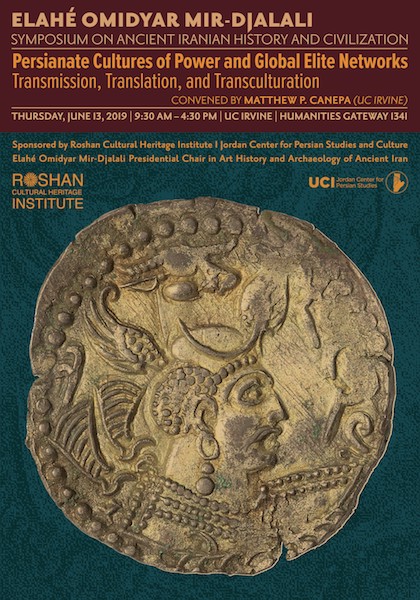
Elahé Omidyar Mir-Djalali Symposium on Ancient Iranian History and Civilization: Persianate Cultures of Power and Global Elite Networks, at UC Irvine, June 13, 2019

Roshan Cultural Heritage Institute is pleased to announce that the Elahé Omidyar Mir-Djalali Symposium on Ancient Iranian History and Civilization, titled “Persianate Cultures of Power and Global Elite Networks: Transmission, Translation and Transculturation,” successfully took place on Thursday, June 13, 2019, at UC Irvine’s Humanities Gateway.

The conference included ten scholars from the United States and Europe who presented papers on the topic, and took part in discussions with an audience of nearly 80 members of the community as well as students and faculty.

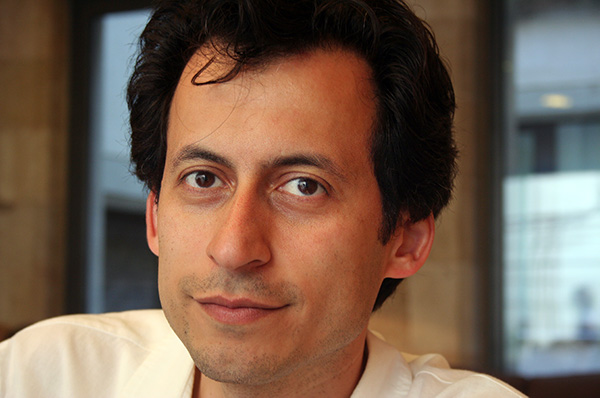
This symposium was organized by Professor Matthew Canepa, Elahé Omidyar Mir-Djalali Presidential Chair in Art History and Archaeology of Ancient Iran at UC Irvine, who presented a paper entitled, “Toward a New Transmillennial Understanding of Persianate Visual and Spatial Cultures: Theorizing Transmission, Translation, and Transculturation.” Opening remarks were made by Professor Touraj Daryaee, Maseeh Chair and Director of the Samuel Jordan Center for Persian Studies and Culture at UC Irvine.

Find out more about Professor Matthew Canepa

Find out more about UCI Jordan Center

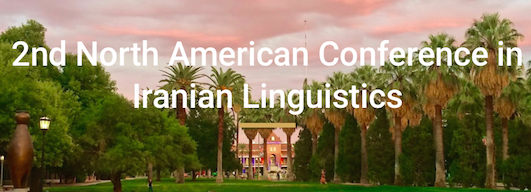
Second North American Conference in Iranian Linguistics at The University of Arizona, April 19-21, 2019

Roshan Cultural Heritage Institute wishes to congratulate the University of Arizona Department of Linguistics, and in particular Professor of Linguistics Simin Karimi, for successfully organizing the Second North American Conference in Iranian Linguistics (NACIL 2) that was held on April 19-21, 2019, at the UA.

Sponsored by Roshan Cultural Heritage Institute, NACIL 2 provided attendees an opportunity to present recent academic research on a diverse range of topics in syntax, semantics, morphology and phonology of Persian and many other Iranian languages. The conference keynote speakers included Dr. Arsalan Kahnemuyipour, Associate Professor of Linguistics at the University of Toronto; Dr. Agnes Korn, Researcher at the Centre National de la Recherche Scientifique, France; and Dr. Richard Larson, Professor of Linguistics at Stony Brook University. Professor Larson was the principal organizer of NACIL 1, which was held at Stony Brook University in April 2017, with a grant from Roshan Cultural Heritage Institute.

Invited guest speakers to NACIL2 were UA Laureate Professor of Linguistics Noam Chomsky, who presented two talks, one on his most recent views regarding the current developments of Generative Linguistics and a second talk on political issues related to Iran; and UCLA Professor of Linguistics Anoop Mahajan who presented a talk about Indo-Iranian linguistics.

Roshan Cultural Heritage Institute is delighted to announce that NACIL 3 will take place in April 2021, at UCLA.

Find more about the conference

Noruz Mobarak from Roshan Cultural Heritage Institute!

This most cherished Persian celebration goes back at least 3000 years and is about “Celebrating Life renewal in health and harmony with nature”

Noruz – literally “New Day” – is the Persian New Year and symbolizes renewal and rebirth. Noruz starts at the exact instant of the Vernal Equinox, which occurs each year around the 21st of March, the first day of spring. This most important Iranian holiday is a time for family and friends to gather together and is marked with a myriad of activities affecting everything from preparations and celebrations to food, clothing, gift giving, charity, and many other social and family activities.

Haftsin (Haft Seen) is the spread, around which the Family gathers to celebrate Noruz. Iranians take pride in putting together an attractive and elaborate spread to represent both spiritual and worldly symbols promising a happy start of the New Year. The Persian word Haft means seven and Sin refers to the sound /S/ in the language. Usually a nice embroidered fabric is used as the foundation of the spread. On the spread seven specific items starting with the sound /S/ are displayed. The set is prepared a day or two before Noruz and given a place of honor in the house to remain 13 days following Noruz. Additional items are also placed on the Haftsin that will signify renewal, life, happiness, spiritual purity, prosperity, fertility, growth, good health and all things one desires for the New Year. This celebration is one of hope, promise and good fortune to enjoy and share with friends and family.

List of items for Haftsin

# Name Definition Symbolism
1 Sabzeh Spring Sprouts Growth, prosperity and togetherness
2 Senjed Dry fruit of lotus, “mountain-ash” Tart and sweet tastes in life
3 Seeb Apple The oldest beneficial fruit
4 Samanu Wheat Pudding A sweet prepared with the extract of young growth of wheat
5 Serkeh Vinegar An astringent agent, medicinal
6 Somagh Crushed Sumac Berries The oldest beneficial condiment derived from a plant
7 Seer Garlic The oldest bulb with medicinal Value
8 Sekkeh Coins, (Silver and Gold) Permanence and prosperity
9 Sombol Hyacinth Flower Life development: flower from the bulb to the roots
10 Mahi Gold fish Life energy
11 Ayne A Mirror Purity and clarity
12 Sham’ Two Candelabras Spiritual light and warmth
13 Tokhm-e Morgh Decorated Eggs Life in potential
14 Scriptures Koran, Bible, Torah, etc. Blessings and faith
15 Sepand, Esfand Wild Rue Incense against the evil eye that helps the lungs function

New Grant for two-year Elahé Omidyar Mir-Djalali Postdoctoral Fellowship in Iranian Linguistics at the University of Toronto

Roshan Cultural Heritage Institute has awarded a new grant to the University of Toronto to fund a two-year Elahé Omidyar Mir-Djalali Postdoctoral Fellowship in Iranian Linguistics, in support of Dr. Arsalan Kahnemuyipour’s current research project on the syntax of nominal linkers.

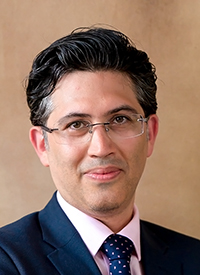
Dr. Arsalan Kahnemuyipour (pictured) is Associate Professor of Linguistics at the Department of Language Studies, University of Toronto Mississauga campus, and at the Department of Linguistics, Faculty of Arts and Science (St. George campus). His areas of expertise are syntax, morphology and the syntax-phonology interface. He earned his Ph.D. in Linguistics from the Department of Linguistics at the University of Toronto in 2004 and was an Assistant Professor of Linguistics at the Department of Languages, Literatures and Linguistics, Syracuse University from 2004 to 2010.

In 2018, Dr. Kahnemuyipour was awarded a grant from the Social Sciences and Humanities Research Council of Canada (SSHRC) to launch a six-year research project (2018-2023) on nominal linkers. The project is to focus on Iranian languages in its first phase, lasting two to three years, and expand the research to other languages in the second phase.

The selected Elahé Omidyar Mir-Djalali Postdoctoral Fellow in Iranian Linguistics will play a critical role in the first phase of the project, which will include a systematic comparative investigation of Persian and other Iranian languages. This investigation will seek to establish the properties of nominal linkers in each of the Iranian languages, starting with the Persian case known as the Ezafe. A comparative study of these Iranian languages will enrich our understanding of the nominal-linker phenomenon and the structure of these languages, and help place the languages on the map of linguistic research. In addition, the project will help document Iranian languages (some of which may be endangered), and thus contribute directly to the preservation of Persian culture.

The position is expected to start in Fall 2019.

Find more about the Postdoctoral opportunity

Read more about the Syntax on Nominal Linkers project

RCHI Board of Directors appoints Dr. Kaveh Abhari to the position of Vice Chair

The Board of Directors of Roshan Cultural Heritage Institute is delighted to announce the appointment of Director Kaveh Abhari, Ph.D., to the position of Vice Chair. In his new role, Dr. Abhari will be assisting RCHI Founder and Chair, Dr. Elahé Omidyar Mir-Djalali, with her ever-expanding work and accomplishments in support of the Institute’s mission.

Dr. Abhari has been versed in the work of Roshan Cultural Heritage Institute since 2011, first as a volunteer student aide and, later, as a website and cultural Consultant, while also occasionally serving as a Program Officer. He was elected to RCHI Board of Directors in May 2018.

Dr. Abhari currently is an Assistant Professor of Management Information Systems (MIS) within the Fowler College of Business at San Diego State University and an Affiliate Faculty at the University of Hawaii at Manoa. He previously was an Adjunct Assistant Professor and MIS Lecturer at the University of Hawaii at Manoa, where he earned an interdisciplinary Ph.D. in Communication and Information Sciences. He also has a B.S. and M.S. in Electrical Engineering from his native Iran.

Please join us in congratulating Dr. Abhari in his new position!

Congratulations to Professor Matthew Canepa on the release of his second book, The Iranian Expanse

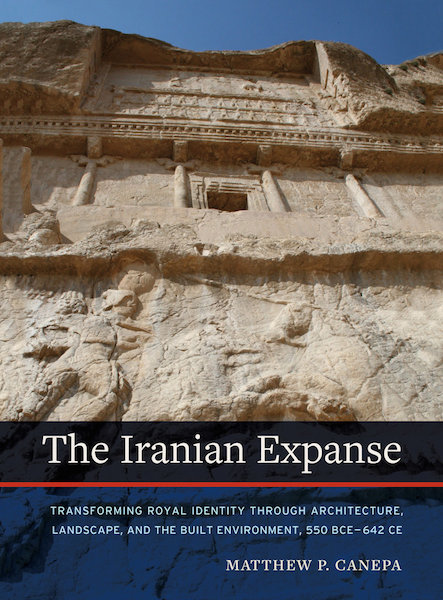
Roshan Cultural Heritage Institute wishes to congratulate Dr. Matthew Canepa, Professor of Art History and Elahé Omidyar Mir-Djalali Presidential Chair in Art History and Archaeology of Ancient Iran at UC Irvine, on the release of his second book, The Iranian Expanse: Transforming Royal Identity through Architecture, Landscape, and the Built Environment, 550 BCE-642 CE (University of California Press, 2018).

The Iranian Expanse covers 1,000 years of art, archeology and history of ancient Iran, from the Achaemenid period to the arrival of Islam, and explores how kings in Persia and the ancient Iranian world utilized the built and natural environment to form and contest Iranian cultural memory, royal identity, and sacred cosmologies. This large-scale study critically examines the construction of a new Iranian royal identity and empire, which subsumed and subordinated all previous traditions, including those of Mesopotamia, Egypt, and Anatolia. It then delves into the startling innovations that emerged after Alexander under the Seleucids, Arsacids, Kushans, Sasanians, and the Perso-Macedonian dynasties of Anatolia and the Caucasus, a previously understudied and misunderstood period.

Professor Canepa is an award-winning historian of art, archaeology and religions of Persia and wider Iranian world. His first book, The Two Eyes of the Earth (University of California Press, 2009; paperback edition, 2017,) is a pioneering comprehensive study of the artistic, ritual and ideological interactions between the late Roman and Sasanian empires. It was awarded the 2010 James Henry Breasted Prize from the American Historical Association for best book in English on any field of history prior to the year 1000 CE and the Archaeological Institute of America’s von Bothmer Publication Fund.

Learn more about The Iranian Expanse

Congratulations to Dr. Anousha Sedighi on her recent publication, The Oxford Handbook of Persian Linguistics

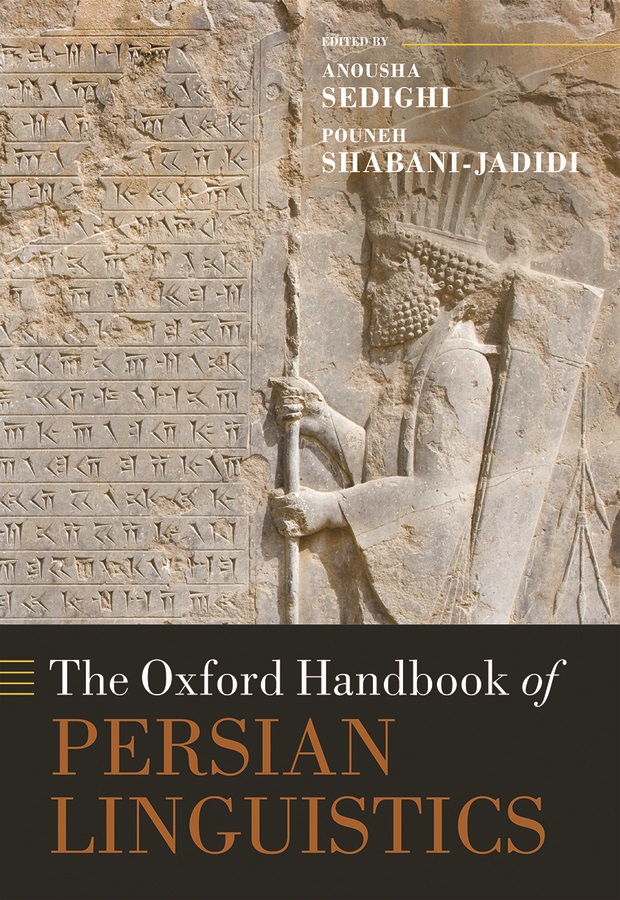
Roshan Cultural Heritage Institute is delighted to announce the publication of The Oxford Handbook of Persian Linguistics (Oxford University Press, 2018) edited by Dr. Anousha Sedighi and Dr. Pouneh Shabani-Jadidi.

The Oxford Handbook of Persian Linguistics offers a comprehensive overview of the field of Persian linguistics, discusses its development, and captures critical accounts of cutting edge research within its major subfields, as well as outlining current debates and suggesting productive lines of future research. Leading scholars in the major subfields of Persian linguistics examine a range of topics split into six thematic parts. 

Following a detailed introduction from the editors, the volume begins by placing Persian in its historical and typological context in Part I. Chapters in Part II examine topics relating to phonetics and phonology, while Part III looks at approaches to and features of Persian syntax. The fourth part of the volume explores morphology and lexicography, as well as the work of the Academy of Persian Language and Literature. Part V covers topics such as language contact and teaching Persian as a foreign language, while the final part examines psycho-, neuro-, and computational linguistics. The volume is an essential resource for all scholars with an interest in Persian language and linguistics.

Dr. Anousha Sedighi is Professor of Persian and Head/Founder of the Persian program at Portland State University. She has published two other books, Agreement Restrictions in Persian (Rozenberg & Purdue, 2008) and Persian in Use: An Elementary Textbook of Language and Culture (Leiden University, 2015) for which she received a Roshan Institute Fellowship for Excellence in Persian Studies in 2010. Persian in Use has been re-published for the fourth time since 2015 due to popular demand and is currently used at more than 20 universities in the U.S. as well as internationally in Germany, Italy, the Netherlands and Canada.

Dr. Pouneh Shabani-Jadidi is Senior Lecturer of Persian Language and Linguistics at the Institute of Islamic Studies, McGill University. She has published on morphology, psycholinguistics, translation, teaching Persian as a second language, and second language acquisition.

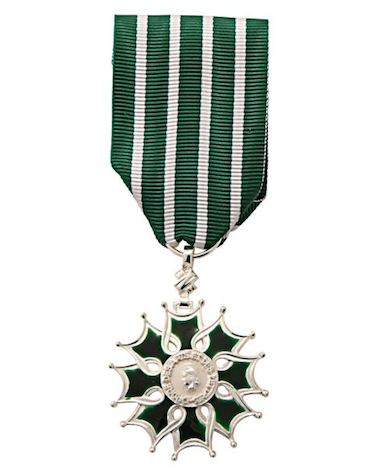
Dr. Elahé Omidyar Mir-Djalali Awarded Most Honorific French Medal of Chevalier de l’Ordre des Arts et des Lettres

The Board of Directors of Roshan Cultural Heritage Institute proudly wishes to announce that its Chair and President, Dr. Elahé Omidyar Mir-Djalali, has been bestowed upon one of France’s most distinguished titles, that of Knight in the French Order of Arts and Letters, known in French as Chevalier de l’ordre des Arts et des Lettres.

Given by the French Ministry of Culture, the award recognizes eminent artists and writers, and those who have contributed significantly to furthering the arts and culture in France and throughout the world. Our Chair and President could not be more deserving of the title. As a linguist, scholar, and most generous philanthropist, Dr. Mir-Djalali has dedicated (and continues to dedicate) her long and distinguished career to improving communication and cultural understanding across borders, focusing her efforts specifically to bringing to light the richness and diversity of Persian culture to audiences in France and around the world.

Dr. Mir-Djalali has been sharing her knowledge of—and passion for—Persian language and culture ever since completing her Ph.D. in Linguistics at the Sorbonne, Université de Paris, where her dissertation, Transformational Structure of the Verb in Persian, was awarded Honorable mention. Her academic skills led her to teaching at Georgetown University and the University of California at Berkeley, while her interest in Persian mystical and educational poetry and prose resulted in 15 years of volunteered work translating texts of Sufi masters, from Persian into French and English.

But, beyond these already laudable accomplishments, Dr. Mir-Djalali has established herself as a most brilliant—and generous—philanthropist since founding in 2000 Roshan Cultural Heritage Institute, a private foundation dedicated to promoting the preservation, transmission and instruction of Persian language and culture around the world. Under her leadership and extraordinary vision, Roshan Cultural Heritage Institute has provided countless endowments, grants and fellowships in support of Persian-related educational and cultural activities, as demonstrated on this website.

Her strong professional and personal link to France led to the gift of a significant endowment to the prestigious Musée du Louvre in 2011 for the establishment of the Elahé Omidyar Mir-Djalali Fund—the first endowed fund within the Louvre Endowment Fund—to underwrite educational programs relating to Persian art and culture. Many of the programs supported by the Elahé Omidyar Mir-Djalali Fund recall the deep cultural ties that have linked France and Iran for centuries, as was most recently revealed through the hugely successful exhibition, The Rose Empire, on the magnificent art of the Qajar dynasty that took place earlier this year at the Louvre-Lens Museum.

It is in recognition of this unwavering advocacy and contribution to the promotion of the arts and culture that the Louvre selected Dr. Mir-Djalali to receive the honorific title and medal of Chevalier de l’ordre des Arts et des Lettres.

“I am proud to have been the initiator of the first endowment fund in support of educational and cultural programs at that grand Institution,” said Dr. Mir-Djalali upon learning from the Musée du Louvre of the award bestowed upon her. “It is delightful to see that the efforts of everyone involved are being recognized symbolically by awarding me the Chevalier medal.”

Please join the Board and Staff of Roshan Cultural Heritage Institute in congratulating their Chair and President for this most deserving honor.

Elahé Omidyar Mir-Djalali Symposium on Persian Language and Literature: Literary Translation in Iran at UC Irvine, December 7, 2018

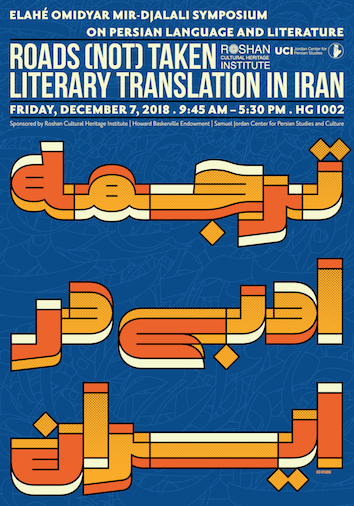
Roshan Cultural Heritage Institute is pleased to announce the Elahé Omidyar Mir-Djalali Symposium on Persian Language and Literature titled “Roads (Not) Taken: Literary Translation in Iran” that will take place on Friday, December 7, 2018, 9:45 am – 5:30 pm, in UC Irvine’s Humanities Gateway (HG) 1002.

For more than two centuries literary translation has played a key role in Iran’s intellectual life and literary production. Literary translation has also impacted Iran’s political, social, and cultural trends. The participants in this conference will analyze how literary translation has influenced or shaped Persian literature and culture.

This event is organized by Dr. Nasrin Rahimieh, Howard Baskerville Professor of Comparative Literature at UC Irvine’s School of Humanities. Opening remarks will be made by Professor Touraj Daryaee, Maseeh Chair and Director of the Samuel Jordan Center for Persian Studies and Culture at UC Irvine. The day-long symposium will be divided into four panels on the topics of Conceptual and Theoretical Frames, Literary Translation Then and Now, Politics of Translation, and Anomalies of Literary Translation.

This event is free and open to the public. No registration is required.